How many lumens do you need in a headlamp?

For most camping and hiking, a headlamp that tops out at 300 to 400 lumens is plenty, and close-up camp tasks need 100 lumens or fewer. Trail running and off-trail route-finding are where 400 to 600 lumens and a tight, far-reaching beam start to matter. Whatever number is on the box, it is the peak of the brightest mode, so read it next to the runtime for that same mode.
What does a lumen measure, and what does it leave out?
A lumen is a unit of total light output: all the light leaving the lamp, added up in every direction. It says nothing about where that light goes. Three numbers describe a headlamp:
- Light output (lumens): how much light the lamp produces in total.
- Beam distance (feet or meters): how far the brightest part of the beam reaches. That depends on how tightly the lens focuses the light, measured as peak beam intensity in candela.
- Runtime (hours): how long a mode lasts on a full battery.
Petzl says lighting distance depends mainly on the shape of the beam, and Black Diamond notes that lumens are not always an indicator of beam distance. One 400-lumen lamp lights a wide pool at your feet, another throws its light down the trail.
How are lumens, beam distance and runtime measured?
The common yardstick is the FL 1 standard. It was first approved as ANSI/NEMA FL 1 in 2009 and is now maintained by PLATO, the Portable Lights American Trade Organization, which revised it in 2016 and 2019 and published the current edition, ANSI/PLATO FL 1-2025, in February 2026. Petzl's summary of the FL 1 protocol and PLATO's own guidance describe the three headline numbers like this:
| Number on the box | How FL 1 defines it | What it means for you |
|---|---|---|
| Light output (lumens) | Measured 30 seconds to 2 minutes after switch-on, on a fresh or fully charged battery | It is the starting output of that mode, not an average |
| Beam distance | The distance at which the beam has faded to 0.25 lux | At that distance you get about full-moon light, so treat it as the outer limit |
| Runtime | Time from the 30-second reading until output falls to 10% of it | A 300-lumen mode still counts as running at 30 lumens |
Streamlight's summary of the standard describes 0.25 lux as roughly the light of a full moon on a clear night. Beam distance is calculated, not paced out: it is the square root of the peak beam intensity in candela divided by 0.25. A lamp with 2,500 candela gets a beam distance of about 330 ft (100 m), and doubling that distance takes four times the candela.
REI explains the runtime rule with a 300-lumen lamp: its FL 1 runtime ends when the light has dimmed to 30 lumens. So a long runtime can include many hours at a fraction of the headline brightness. REI notes that one popular model went from 60 hours on the box to 2 hours when its maker adopted the standard.
FL 1 is voluntary
PLATO describes FL 1 as a voluntary performance standard. Lamps tested to it can carry FL 1 icons on the packaging. Plenty of headlamps print lumens, distance and hours with no method named at all. Those numbers may be honest, but you cannot assume they were taken the same way.
Turbo modes and step-down
On small lamps the brightest mode often does not last. Olight, a flashlight maker, explains why: a high-power LED in a small body heats up fast, so the electronics cut the current when a temperature limit or a timer is reached. PLATO notes that turbo and boost modes may hold their peak for only seconds. The 2025 edition of FL 1 added a separate test for them: output is measured in the first 1 to 10 seconds, and the stated runtime ends once output falls to 90% of that peak.
Regulated and unregulated output
REI and Petzl both describe two designs. An unregulated lamp is brightest in its first minutes and fades as the battery drains. A regulated lamp holds a steady level for a set time, then drops, sometimes abruptly, to a dim reserve or to nothing.
How many lumens do you need for each activity?
There is no standard for this. The ranges below are guidance taken from REI's headlamp test and buying advice and Black Diamond's headlamp guide, with beam types from Petzl. A lamp with a higher maximum and good low modes covers several rows.
Lumens by activity
| Activity | Lumens (guidance) | Beam that matters | Source of the range |
|---|---|---|---|
| Reading, cooking, camp chores | 100 or fewer for close work; 150 to 250 is ample | Wide flood | REI, Black Diamond |
| Walking a maintained trail | A low mode is usually enough; a lamp rated about 300 gives headroom | Flood or mixed | REI |
| Hiking or backpacking on rough trail | Above 300 or so | Mixed: flood plus spot | REI |
| Trail running | 200 as a minimum; 400 to 600 for long night runs | Spot, with flood for side vision | REI's night trail running tips for 200, Black Diamond for 400 to 600 |
| Off-trail route-finding, scanning far ahead | 400 and up, with a short high burst in reserve | Tight spot; check beam distance | Black Diamond |
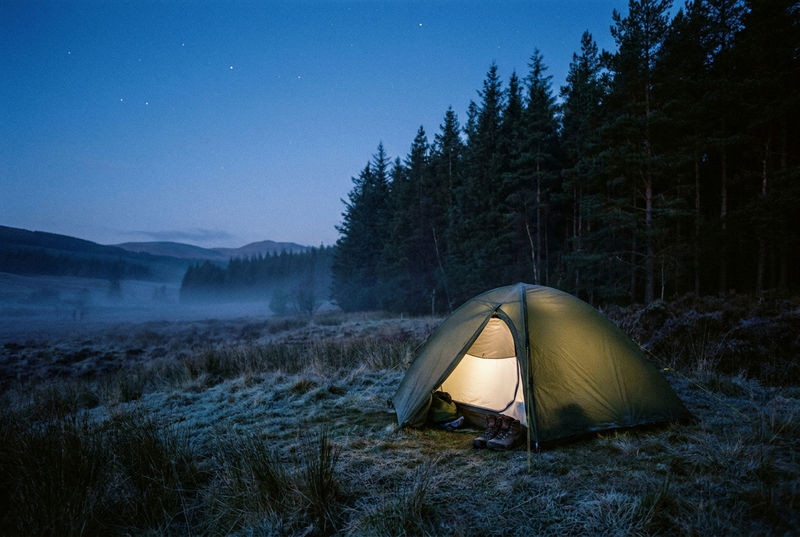
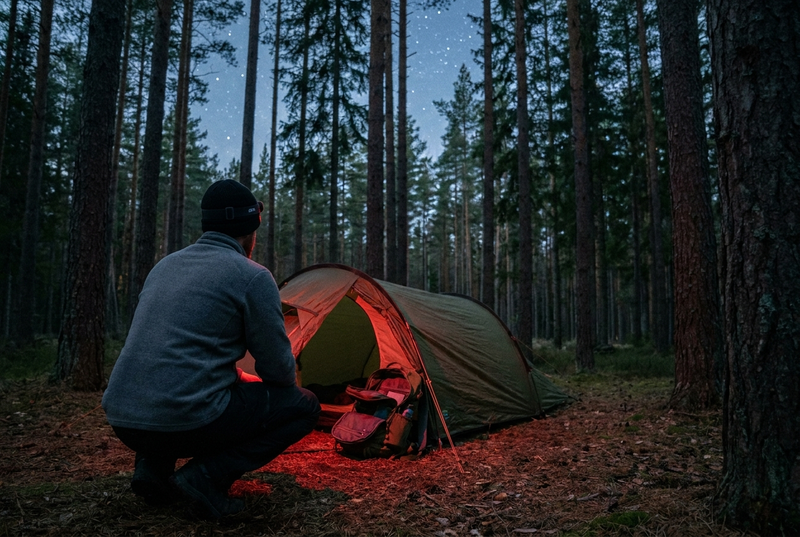
REI's testers packed up camp before dawn on a 7-lumen setting. Inside the tent a few lumens are enough to sort out your bag and pad, and the rest of a comfortable night is covered in our guide to how to sleep warm in a tent.
Flood or spot: which beam do you need?
Petzl sorts beams into three types. A wide beam gives even, close light for camp, reading and slow movement. A mixed beam adds a focused center for depth and suits hiking and trekking. A focused beam concentrates the light for long-range vision, which is what runners, skiers and navigators need. Petzl adds that a flood beam is not suited to distance vision in the mountains, and a focused beam works poorly for reading a map. REI calls lamps that switch between flood and spot the most versatile.
Why more lumens is not always better
- Runtime: Petzl puts it plainly: for a given amount of energy, more brightness means less burn time.
- Glare in bad weather: the US National Weather Service tells drivers never to use high beams in fog because they cause glare. An REI tester noticed something similar on a night walk: at full power the beam lit up the dust hanging in the air. In fog, rain or falling snow, try a lower mode and tilt the beam toward the ground.
- Close work: a beam meant for a hillside is far too much for a map or a page held near your face. Use a low flood mode.
- Other people: a lamp on high is unpleasant to look into. Dim it or tilt it down in camp.
How to read lumens and runtime together: a worked example
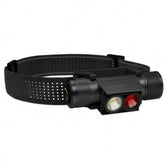
Petzl warns that when a lamp advertises very high brightness and very long burn time, the two usually belong to different modes: brightness to the maximum, burn time to the minimum. Take the Restwild Backcountry Duo Headlamp. Its page states up to 1,000 lumens on white and three white runtimes: 6 to 8 hours on Ultra, 16 to 18 hours on High and 55 to 59 hours on Low. The honest reading is that the 1,000 lumens goes with the 6 to 8 hour line, and the 55 to 59 hours belongs to the Low mode. The page does not say which test method produced the figures, so treat them as the maker's own, and do not assume the full output is held for every hour of a mode. Plan a long night around High or Low and keep Ultra for the moments you need to see far.
Batteries, water resistance, weight and red light
Batteries
REI's advice for cold weather is that lithium batteries outperform alkaline ones, and that rechargeable NiMH cells also do well in the cold. Rechargeable batteries tend to lose charge while sitting idle, so top up before a trip and carry a backup.
Water resistance: IPX4, IPX6 and IPX7
IP codes come from the international standard IEC 60529. Petzl's guide to IP ratings explains that the second digit is water protection and that an X means the lamp was not tested against dust. The three ratings you will see most often on headlamps:
- IPX4: water splashed from any direction. Petzl calls this suitable for most headlamp use in rain and snow.
- IPX6: powerful water jets.
- IPX7: temporary immersion, 3.3 ft (1 m) deep for 30 minutes.
IPX6 is a jet rating, not an immersion rating. It is more than rain asks for, but no promise about a lamp dropped in a lake.
Weight and comfort
According to REI, most headlamps weigh less than 7 oz (about 200 g) with batteries, and brighter lamps tend to need larger or more batteries, which makes them heavier and bulkier. For reference, the Backcountry Duo is rated IPX6 and weighs 2.8 oz (79 g) without its battery. It has no lock mode, so pack it where it cannot be switched on by accident.
Red light
Many headlamps include a red mode because dim red light disturbs your night vision less than white light does. Our guide to red light vs white light covers when it helps.
Frequently asked questions
Is 1,000 lumens too bright for a headlamp?
Not if the lamp also has usable low modes. REI calls 800 lumens overkill for most people, and you will rarely run a top mode for long, but a short burst helps when you need to pick out a marker or a route far ahead.
How many lumens do I need for night hiking?
A lamp that reaches 300 to 400 lumens with a mixed flood and spot beam covers most night hiking. That range is our own reading: REI says a brightness above 300 lumens or so matters once you want to see farther away. On an easy, maintained trail a low mode is usually enough.
What does beam distance mean on a headlamp box?
Under the FL 1 standard it is the distance at which the beam has faded to 0.25 lux, which is about the light of a full moon. It is the outer limit of the beam, not the distance at which you can comfortably read the ground.
Why does my headlamp get dimmer after a few minutes?
Two things can cause it. Many lamps step down from their top mode to control heat, and unregulated lamps fade steadily as the battery drains. Neither is a fault, but both mean the lumen figure on the box describes the start of a mode, not the whole night.