How to follow a blood trail at night: light, method and law

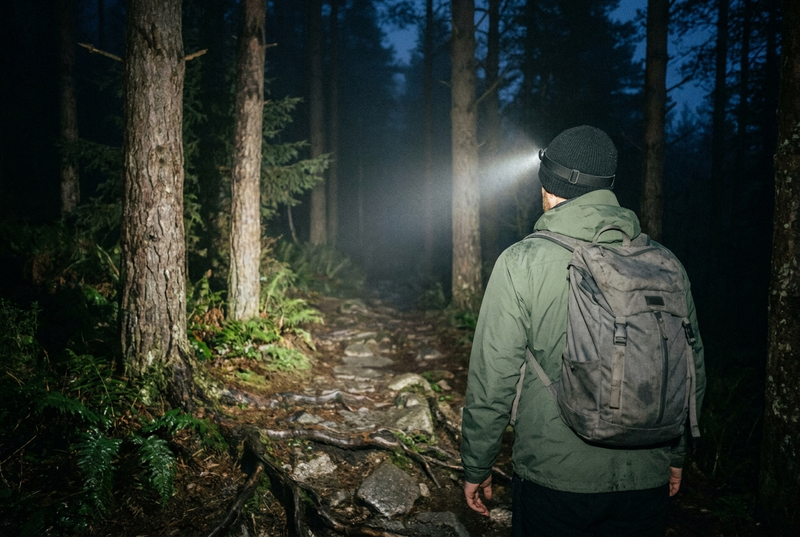
To follow a blood trail at night, first confirm that tracking after dark is legal where you hunt and whether you may carry a firearm or bow while you do it, then wait as long as the hit calls for and work slowly from the last blood with a white light, marking every find. If the sign points to a liver or gut hit, or the trail runs out, back out and return in daylight or with a tracking dog where that is legal.
Is it legal to track a wounded deer after dark?
It depends on the country, state or province, and the rules differ on three points: whether you may use a light, whether you may carry a weapon, and whose land you may enter. Three US examples:
- Wisconsin: the Wisconsin DNR's guidance on lights says that using a flashlight or lantern to find your way, or to follow a blood trail from an animal a hunter has hit, is an accepted practice and not a violation. Shining the light broadly around the area or up into trees to locate wild animals is a violation if you have a firearm, air gun, bow or crossbow with you, or if you do it after 10 p.m. between September 15 and December 31.
- Minnesota: Minnesota Statutes section 97B.081 bars casting a light to spot, locate or take a wild animal while you have a firearm or bow. One exception allows a handheld light, defined as one carried in the hand or attached to the person, to retrieve wounded or dead big game, provided you are on foot and not in possession of a firearm or bow. Section 97B.207 covers tracking a wounded deer or bear with a dog: a valid license for the animal must be in possession, the leash may not exceed 30 ft (9 m), any light must be handheld, the hunter and any handler must be on foot and wearing blaze orange or pink, and trespass law still applies.
- Louisiana: the Louisiana Department of Wildlife and Fisheries describes Act 272, signed in June 2024 and now part of section 56:116.3 of the Louisiana Revised Statutes. It lets a licensed hunter or tracker pursue a legally shot, mortally wounded deer with lights and one blood-trailing dog, on a handheld leash or wearing a GPS tracking collar. A deer found alive after legal hunting hours may be dispatched with a centerfire handgun with a barrel no longer than 6 in (15 cm), in a caliber from .25 to .45. The department's 2026-2027 regulations apply this on private lands only, and the statute lets you follow a deer onto private property only with the landowner's verbal or written permission.
Three states, three different answers. Read your own regulations before the season, and if they are unclear, call the wildlife agency or the local warden before you track.
Property lines are a separate question. Outdoor Life's guide to recovering deer advises checking your state's rules on retrieving game across a boundary and asking the landowner for permission before you keep tracking.
How long should you wait before you follow the trail?
The general rule taught in hunter education courses is to wait at least half an hour to an hour before trailing a deer, unless the downed animal is in sight. The right wait depends on the hit, and the sign at the place where the animal stood is your best evidence. The signs in the table, and the waits for liver and gut hits, are Outdoor Life's. Where it gives no figure, the table falls back on the general rule.
| Sign at the hit site | Likely hit | Wait before trailing |
|---|---|---|
| Bubbly, frothy blood | Lungs | Deer hit well in the heart or lungs die within minutes. Half an hour to an hour is the usual rule |
| Bright red blood without bubbles | Lungs, or only muscle | Half an hour to an hour, then judge again by what you find |
| Dark red, maroon or purplish blood | Liver | At least six hours |
| Clear, yellow or green matter that smells of gut | Stomach or intestines | At least 8 to 12 hours, then return with help |
Outdoor Life adds two cautions. Bright red blood is not proof of a lung hit, because blood from a muscle wound is bright red too. And hunters who believe they hit a little too far back often take up the trail too soon and push the deer out of its first bed, which makes recovery much less likely.
What light works best on a blood trail?
White, because you are looking for a color
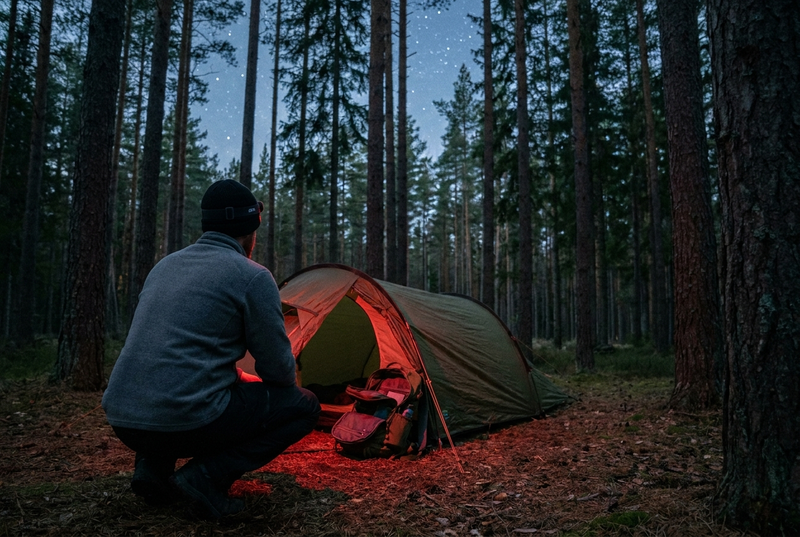
Red light protects your night vision, but it is the wrong tool here. The FAA's Aeronautical Information Manual warns pilots that red light severely distorts colors. Our guide to red light vs white light explains why, and gives the same advice for anything you identify by color: use white.
What about colored blood-tracking lights?
Some lamps offer a blue mode for this job. Outdoor Life's test of hunting headlamps says a blue light can help on a blood trail because it increases contrast against dry, brown leaves. It cites no test for that, and we found no published test that compares light colors on blood sign, so treat a colored mode as an extra, not a replacement for white.
Two lights and spare power
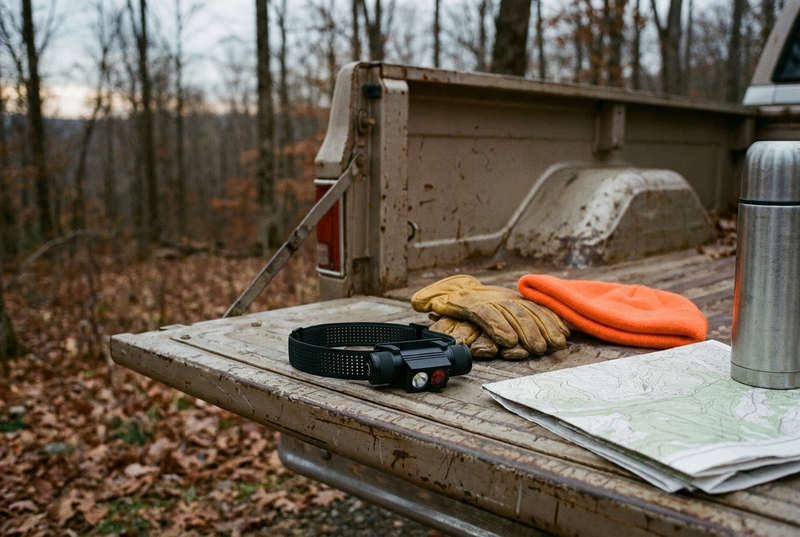
Outdoor Life's packing list for blood trailing includes a headlamp, an ultra-bright handheld flashlight and spare batteries for both.
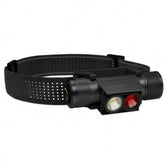
A track can take hours. On the Restwild Backcountry Duo Headlamp, the white light has a stated runtime of 16 to 18 hours on High and 6 to 8 hours on Ultra, the mode that reaches 1,000 lumens. Use its red LED for the walk in, not for the blood. The lamp is rated IPX6 and runs on a rechargeable battery, so start with a full charge and carry a second light.
Hydrogen peroxide
Outdoor Life also recommends hydrogen peroxide in a spray bottle. It foams when it touches blood, which helps most when the trail is down to pinprick drops on damp leaves after dark.
How do you follow the trail, step by step?
- Fix the starting points before you move. Hunter education material tells you to watch every movement of the animal after the shot. Outdoor Life suggests noting landmarks for where the deer stood and where you last saw it, because everything looks different from the ground.
- Read the hit site. Look for blood on the ground or on vegetation, broken twigs, tracks, and hair, meat or bone fragments. Check the ground before you assume you missed.
- Mark each find. Outdoor Life suggests flagging tape or small pieces of tissue paper. Hunter education courses recommend fluorescent orange flagging, so you can pick the trail up again the next day if darkness or weather stops you. Remove it afterwards.
- Check the rules for markers. Some public lands ban them. The hunting regulations for St. Marks National Wildlife Refuge in Florida, for example, prohibit flagging tape and reflective tacks.
- Do not move until you see the next drop. Keep your feet planted, search with your eyes, then advance beside the trail, not on it. Blood you step on is a clue lost.
- Look above the ground. Blood from a high wound can end up on grass, brush and tree trunks, not on the leaves.
- Read the drops. According to Outdoor Life, the ragged side of a drop typically points in the direction the deer was traveling.
- If you lose the trail, go back to the last blood. Hunter education material advises searching in a circular or grid pattern and checking downhill trails, especially toward water.
When should you stop and back out?
Stop when the sign changes to liver or gut, or when the trail runs out and a careful search around the last blood finds nothing. Outdoor Life's advice at that point is to consider backing out and contacting a tracking dog handler, where dogs are legal. It calls a line or grid search by several people a last resort, because afterwards a dog will struggle to pick up the trail.
What do you do when you find the animal?
Approach it carefully. Hunter education guidance on approaching downed game says to come from above and behind the head, wait a short distance away for a few minutes and watch for any rise and fall of the chest. The eyes of a dead animal are usually open, and you can be certain it is dead if the eye does not blink when touched with a stick.
If the animal is still alive, stay back. What you may do after legal hours depends on the rules at the top of this guide.
How do you stay safe on a night track?
- Tell someone. Leave your location, your companions and your expected return time with a family member or friend, as hunter education courses teach for any hunt, and update them when a track takes you somewhere new.
- Bring a partner if you can. Outdoor Life suggests one person works the blood while the other watches ahead.
- Record your route. Turn on tracking in a mapping app or GPS watch. Outdoor Life notes that GPS can be off by a few feet, so mark the trail physically as well.
- Stay visible. Other hunters may still be in the woods. Wear your orange.
- Handle any weapon as if it were daylight. If the law lets you carry one, control the muzzle and never shoot at sound or movement.
The lamp features that matter for this kind of night are in how to choose a headlamp for hunting, and brightness is covered in how many lumens you need in a headlamp.
Gear mentioned: the Restwild Backcountry Duo Headlamp. See all headlamps and camp lighting.
Frequently asked questions
What color light is best for following a blood trail?
White. You are looking for a color, and single-color light hides color differences: the FAA warns pilots that red light severely distorts colors. Blue modes are said to increase contrast, but we found no published comparison that backs that up.
Can you follow a blood trail with a red light?
Not well. Red light keeps your night vision on the walk in, but it makes colors hard to tell apart. Switch to white when you start looking for blood.
How long should you wait before tracking a deer?
Hunter education courses teach at least half an hour to an hour unless the deer is down in sight. Outdoor Life advises at least six hours for a liver hit and at least 8 to 12 hours for a gut hit.
Can you carry a gun while tracking a deer after dark?
That depends on the state. Minnesota's general exception for retrieving wounded big game with a handheld light applies only if you have no firearm or bow, while Louisiana allows a licensed hunter or tracker to dispatch a mortally wounded deer with a centerfire handgun within set barrel and caliber limits. Check your own regulations before you track.