How to choose a headlamp for hunting: an honest buyer's guide

Choose a hunting headlamp by the jobs it has to do: a dim red or low white mode for the walk in, a bright white mode for tracking and getting out, enough runtime at those levels for your longest day, and a body that handles rain and gloved hands. Peak lumens matter least: Outdoor Life's field test of hunting headlamps calls a 500-lumen lamp plenty for most hunting situations and says under 100 lumens is enough to reach a stand on familiar ground.
How bright does a hunting headlamp need to be?
Less than the packaging suggests. Outdoor Life's tester describes anything over 1,000 lumens as overkill in most scenarios, though the extra brightness could help to light a large area or signal for help. Black Diamond's headlamp guide puts basic uses such as reading and cooking at camp at 150 to 250 lumens and says a count over 400 lumens is what route-finding in challenging terrain calls for. REI's headlamp advice treats the low mode as the standard one for camp chores or walking an easy trail at night.
What matters is whether the lamp has the right level for each job.
| Job | Light level | Beam and color | Where the figure comes from |
|---|---|---|---|
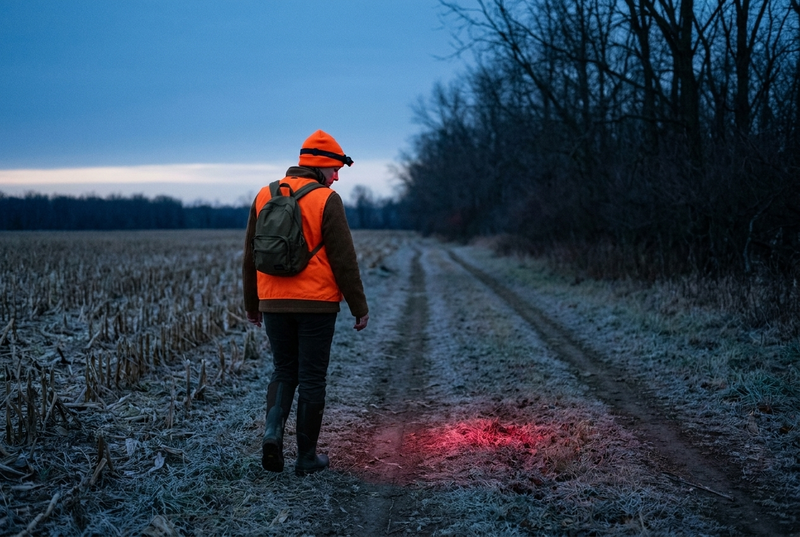
| Walking to or from a stand on a known route | Under 100 lumens | Red or low white, aimed at the ground | Outdoor Life |
| Camp and truck chores, reading | 150 to 250 lumens | Wide flood | Black Diamond |
| Route-finding on rough or unfamiliar ground | Over 400 lumens | Spot or mixed beam, white | Black Diamond |
| Most other hunting situations | About 500 lumens is plenty | White | Outdoor Life |
| Lighting a large area, signaling for help | Over 1,000 lumens could help | Brightest white | Outdoor Life |
How lumens, beam distance and runtime are measured, and why the three numbers on a box rarely describe the same mode, is covered in how many lumens you need in a headlamp.
Do you need a red or green light?
A second color earns its place for two reasons. Dim red light costs you far less night vision than white, which our guide to red light vs white light explains. A colored beam is also widely thought to be less conspicuous to game: Outdoor Life notes that many hunters believe red light is less likely to spook animals, and that some prefer green because it gives better distance vision and makes maps easier to read.
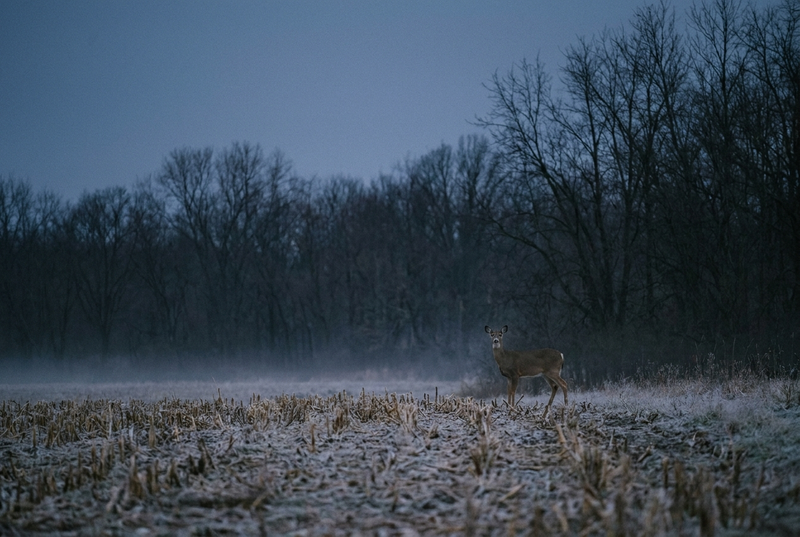
Keep your expectations realistic. The Pennsylvania Game Commission's deer biologists say studies indicate that deer are less sensitive to long, orange and red wavelengths. In the same answer they say a deer can see your flashlight at night regardless of the color. Which of the two colors an animal's eye is better tuned to is the subject of red vs green light for hunting.
What to look for in the lamp itself:
- A colored LED with more than one level. You want the least light that lets you place your feet.
- Red without white first. If the lamp has to pass through white to reach its colored mode, you will flash yourself every time.
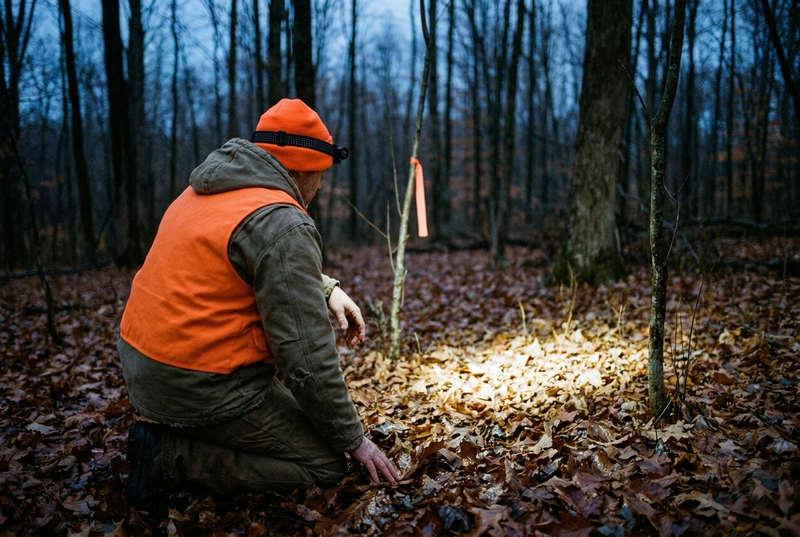
- White as well. A single-color beam hides color differences. For a blood trail, a map or first aid you need white.
Which beam do you need: flood or spot?
REI describes three types. A flood, or wide, beam suits camp tasks, close repair work and reading, and does not ordinarily throw light far. A spot, or focused, beam is the one for long-distance viewing and, in most cases, the better choice for following a trail in the dark. Lamps that adjust between the two are the most versatile.
Hunting uses both ends of that range: width when you are working at your feet, reach when you are picking a route or looking for a trail marker. Treat the beam distance printed on a box as the outer limit of the light, not the distance at which you can read the ground.
How much runtime do you need at the brightness you will really use?
Add up the hours first: the walk in, the walk out, and a reserve for a recovery that runs late. Then read the runtime for the mode you will use during those hours, not the longest figure on the box.
REI explains that the industry changed how it measures runtime. Makers once counted until the lamp no longer gave usable light. The newer standard stops the clock when output falls to 10 percent of the original brightness. In REI's example, a 350-lumen lamp could be listed at 40 hours the old way and 2 hours the new way, so two similar lamps with very different runtimes may simply have been measured differently.
Power source matters as much as the number:
- Cold: REI says lithium batteries outperform alkaline ones in cold conditions.
- Storage: rechargeable batteries tend to lose power while sitting idle, according to REI. Charge the lamp before each hunt.
- Backup: Outdoor Life calls lamps that can also run on disposable batteries a wise choice for remote hunts. If yours cannot, carry a second light or a spare charged cell.
How much should a hunting headlamp weigh?
According to REI, most headlamps weigh less than 7 oz (about 200 g) with batteries, and you only see big differences among very high-powered models, which add top straps and external battery packs. Outdoor Life's test included a walk with and without a hat, which is a check worth copying. When you compare weights, see whether the figure includes the battery.
What water resistance rating should you look for?
IP codes come from the international standard IEC 60529. Petzl's guide to IP ratings explains that the second digit describes protection against water and that an X in place of the first digit means the lamp was not tested against solids such as dust.
- IPX4: spraying water. Petzl calls this suitable for most headlamp use in rain, snow or a humid environment.
- IPX6: powerful water jets.
- IPX7: temporary immersion, 3.3 ft (1 m) deep for 30 minutes.
- IPX8: prolonged immersion, to a depth and time set by the maker.
Treat IPX4 as the floor for hunting in weather. If the lamp could end up under water, look for a 7 or an 8. A jet rating is not an immersion rating.
Can you work it with gloves on, in the dark?
REI's advice is to try the buttons and see whether you like how the lamp cycles through its modes. Outdoor Life's tester judged how intuitive each lamp was to operate for the same reason: in the woods you have to change the light quickly. Put on the gloves you hunt in and check three things at home:
- You can find the switch by feel.
- You know the press sequence for your walking mode without looking.
- The head tilts and stays where you put it. REI points out that tilt lets you aim the beam exactly where you want it.
Do you need a lockout?
REI notes that some switches lock so the lamp cannot be turned on by accident inside a pack, and Black Diamond lists a lock mode among the settings on most of its lamps. A lamp that switches itself on in a pack can be flat when you need it. Without a lock, carry it where nothing can press the switch.
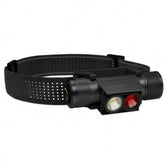
How does the Restwild Backcountry Duo measure up?
Here is our own lamp, the Restwild Backcountry Duo Headlamp, against the same list, including where it falls short.
- Brightness: up to 1,000 lumens on white, with Ultra, High and Low levels plus a dimmer and a strobe, and a stated beam distance of 490 ft (150 m). The output of High and Low is not stated, and neither is the test method.
- Second color: a separate red LED, called ULTRA RED, with its own Ultra, High and Low levels. There is no green light.
- Runtime: stated as 6 to 8 hours on white Ultra, 16 to 18 on High and 55 to 59 on Low. On red: 10 to 13, 20 to 23 and 65 to 69 hours. The longest figure belongs to red Low, not to the 1,000-lumen mode.
- Weight and size: 2.8 oz (79 g) without the battery, 3.5 x 1.0 in (89 x 25 mm). The weight with the cell fitted is not stated.
- Water resistance: IPX6, the jet rating. That is more than rain asks for and no promise about immersion.
- Build and aim: machined aluminum housing, with 180 degrees of tilt.
- Power: a rechargeable 18650 battery, included. No disposable-battery option is listed, so plan your backup around a second light.
- Lockout: none. Pack it where the switch cannot be pressed.
It is the wrong lamp if you want green light, a lockout or an immersion rating.
Is it legal to carry a light while you hunt?
The rules vary by country, state and province. One example: the Wisconsin DNR's guidance on lights says that using a flashlight to find your way through the woods or to follow a blood trail is an accepted practice, while shining the light broadly around the area to locate wild animals is a violation if you are carrying a firearm, air gun, bow or crossbow, or if it is done after 10 p.m. from September 15 to December 31. Read the current regulations where you hunt. Our guides to walking to your stand in the dark and following a blood trail at night give more examples.
Gear mentioned: the Restwild Backcountry Duo Headlamp. See all headlamps and camp lighting.
Frequently asked questions
How many lumens do you need in a headlamp for hunting?
Outdoor Life's field test calls a 500-lumen lamp plenty for most hunting situations and says under 100 lumens is enough to get to and from a stand on familiar ground. It describes anything over 1,000 lumens as overkill in most scenarios.
Is a red or green headlamp better for deer hunting?
Red is the better choice if you want to be less conspicuous, because the Pennsylvania Game Commission says studies indicate deer are less sensitive to long, orange and red wavelengths. It also says a deer can see a flashlight of any color, so keep any light dim and low.
Is IPX4 enough for hunting in the rain?
For rain and snow, yes. Petzl describes IPX4 as suitable for most headlamp use in rain, snow or a humid environment. Choose IPX7 or IPX8 only if the lamp could end up under water.
Should a hunting headlamp be rechargeable?
A rechargeable lamp is convenient, but REI notes that rechargeable batteries tend to lose power while sitting idle, so charge it before each hunt. Outdoor Life calls lamps that can also run on disposable batteries a wise choice for remote hunts. Failing that, carry a second light.