Red vs green light for hunting: what game animals can see

Going by published measurements, the eyes of deer, pigs, dogs and foxes are all tuned much closer to green light than to red, so red should be the less conspicuous color for the animal, and green is the one that looks brighter to you. That is a reading of eye measurements, not a field result, and neither is invisible: the Pennsylvania Game Commission's deer biologists say a deer can see your flashlight at night regardless of the color.
How do red and green light differ?
Color is wavelength. HyperPhysics, the physics reference hosted by Georgia State University, gives about 550 nm as a characteristic wavelength for green and about 665 nm for red, and stresses that such figures are a general guide, so the LEDs in a real lamp may differ. The same reference puts the peak sensitivity of the human eye at 555 nm in bright light and at 507 nm once the eye is dark adapted.
Two things follow for the person wearing the lamp:
- Green looks brighter to you. A green beam sits almost on your eye's daytime peak and a red one far from it. That fits what Outdoor Life's hunting headlamp test reports: some hunters prefer green to red because it gives better distance vision and makes maps easier to read.
- Green should cost you more night vision. Your dark-adapted peak, 507 nm, is also far closer to green than to red. This is our reading of the figures, and it matches the reason red is the traditional color for protecting night vision, which we explain in red light vs white light.
What can deer see?
The basic measurements come from Jacobs and colleagues' 1994 paper in the Journal of Comparative Physiology A, which studied the retinas of white-tailed deer and fallow deer. Both have rods with peak sensitivity at about 497 nm and two classes of cone. One is tuned to short wavelengths, 450 to 460 nm. The other is tuned to middle wavelengths: about 537 nm in whitetails and 542 nm in fallow deer. There is no third, long-wavelength cone of the kind humans use to see red.
Green, at about 550 nm, lies right next to the deer's middle-wavelength cone. Red, at about 665 nm, is far from all three pigments. On the measurements alone, a green beam should look brighter to a deer than a red beam of the same output.
The Pennsylvania Game Commission's deer biologists answer the flashlight question directly. They write that studies indicate deer are less sensitive to light of long wavelengths, orange and red, and in low light deer are likely more sensitive to the blue to blue-green part of the spectrum. Then comes the caveat that matters most: a deer can see your flashlight at night whatever its color. It may not be able to tell the color, but that does not reduce its ability to detect the light.
The behavioral studies described in our red light vs white light guide found the same pattern: more sensitivity to short wavelengths, less to long ones, and no blindness to red.
What about elk?
We found no published measurement of elk eyes. Jacobs and colleagues note that deer resemble other ungulates, and many other mammals, in having two classes of cone pigment. A similar pattern in elk is a reasonable expectation, not a finding.
What can hogs see?
The measurement here is Neitz and Jacobs' 1989 paper in Visual Neuroscience, which found two classes of cone in the eye of the domestic pig, with peak sensitivity at 439 nm and 556 nm. Like deer, pigs have the retinal basis for two-color vision, not three. The domestic pig is Sus scrofa, the species that feral hogs and wild boar also belong to.
A green beam at about 550 nm lands almost exactly on the upper of those two peaks. Red is roughly 110 nm away from it.
These were laboratory measurements on domestic pigs, not on feral hogs or wild boar, and we found no published field trial of hunting lights on feral hogs.
What can coyotes and foxes see?
For canids the reference is Jacobs and colleagues' 1993 paper on the photopigments of dogs and foxes. It measured the domestic dog, the red fox, the Arctic fox and the island gray fox, and found the same pair of cone pigments in all four: one with a peak at about 555 nm and one at 430 to 435 nm. The dog's rod pigment peaked at about 508 nm.
Coyotes were not among the animals tested, but the coyote belongs to the same genus as the dog, so its eye is probably built the same way. That is an inference, not a measurement. If it holds, green again falls on a peak and red far from one.
For bobcats and other predators, the sources used here contain no measurements, so this guide makes no claim about them.
Peak sensitivities side by side
| Animal | Cone peaks | Rod peak | Source |
|---|---|---|---|
| Human, for reference | 555 nm overall in bright light | 507 nm | HyperPhysics |
| White-tailed deer | 450 to 460 nm and 537 nm | 497 nm | Jacobs and colleagues, 1994 |
| Fallow deer | 450 to 460 nm and 542 nm | 497 nm | Jacobs and colleagues, 1994 |
| Domestic pig | 439 nm and 556 nm | Not given in the abstract | Neitz and Jacobs, 1989 |
| Dog, red fox, Arctic fox, island gray fox | 430 to 435 nm and 555 nm | 508 nm in the dog | Jacobs and colleagues, 1993 |
| Elk, coyote, feral hog | No measurement found | No measurement found | None |
For comparison, green light is about 550 nm and red light about 665 nm.
Which color is less likely to be noticed?
On the measurements, red, for every animal that has been measured. Each has its upper cone peak between 537 and 556 nm, close to green light's 550 nm, and the two measured rod peaks, 497 and 508 nm, are also far nearer to green than to red. A pigment responds less the farther a light is from its peak. That is our reasoning, not a reported result, and four limits apply.
- Less is not zero. The Pennsylvania biologists were writing about deer, but it is reasonable to assume the same of other animals: an eye built for dim light can detect a lamp without telling its color. Treat dim red as a way to be less conspicuous, never invisible.
- The gap differs by animal. The pig's and the dog's upper cone peaks, 556 and 555 nm, match the 555 nm peak of human daytime vision, so nothing in the figures says a hog or a coyote sees red more dimly than you do in good light. The case for red rests mainly on eyes adapted to the dark, and on the whitetail's lower 537 nm peak.
- Brightness and movement count. A red LED on its highest level, swept across a field, is easier to notice than a dim one held still and pointed at the ground. Use the lowest level that does the job.
- The field evidence is thin. We found no published trial comparing red and green lamps on wild deer, hogs or coyotes at hunting distances. Reports that one color alarms animals less are hunter experience, not tested results.
The animal can also smell and hear you whatever you do with the light.
When does green make sense?
When your own vision matters more than staying unnoticed. Green gives your eye more to work with at the same power, so it suits jobs where you need a colored beam with some reach. The price is that the beam should be, on the measurements above, more visible to the animal as well, and harder on your own night vision than red.
For anything you identify by color, use neither. A single-color beam hides color differences, so a blood trail, a map or a wound needs white light. Our guide to following a blood trail at night covers that job.
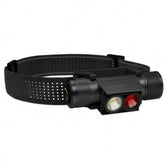
Not every lamp has both colors. The Restwild Backcountry Duo Headlamp has a white LED and a red LED and no green light. Its red LED has three levels, with stated runtimes of 65 to 69 hours on Low, 20 to 23 on High and 10 to 13 on Ultra. The other features worth comparing are in how to choose a headlamp for hunting.
Is it legal to hunt with a red or green light?
That depends on where you are and what you hunt. Two US examples:
- Georgia: the Georgia Department of Natural Resources says feral hogs may be hunted at night with a light, with no voltage restriction, as long as the light is carried by the hunter or fixed to a helmet, hat or belt system. On the state's Wildlife Management Areas, and on National Forest land outside them, no night hunting is allowed.
- Minnesota: Minnesota Statutes section 97B.081 bars casting an artificial light to spot, locate or take a wild animal while you have a firearm or bow. One exception covers fox and coyote from January 1 to March 15, for a hunter on foot with a handheld light, a shotgun and a calling device, who is off the public road right-of-way and not within 200 ft (61 m) of a motor vehicle. The statute counts a light attached to the person as handheld.
Neither text mentions the color of the light. Do not assume a red or green beam is exempt from a rule about artificial light. Rules outside the United States differ again: our red light vs white light guide has examples. Read the current regulations for the place and species you hunt.
Gear mentioned: the Restwild Backcountry Duo Headlamp. See all headlamps and camp lighting.
Frequently asked questions
Can deer see green light?
Yes, and probably better than red. White-tailed deer have a cone with peak sensitivity at about 537 nm, close to green light at about 550 nm, and the Pennsylvania Game Commission says a deer can see a flashlight at night regardless of the color.
Is red or green light better for hog hunting?
On the eye measurements, red should be less visible to a hog than green, because the domestic pig's upper cone peaks at 556 nm, almost exactly at green. Feral hogs themselves were not measured. Green looks brighter to the hunter, so the choice is a trade between your reach and the animal's. No published field trial that we could find has compared the two on feral hogs.
Can coyotes see red light?
Probably. Dogs and three fox species have cone pigments that peak at about 555 nm and 430 to 435 nm. A 555 nm cone should respond to red light more weakly than to green, but it does respond, so expect a canid to see a red lamp. Coyotes themselves were not tested.
Does green light ruin your night vision more than red?
It should, at the same brightness. The dark-adapted human eye is most sensitive at 507 nm, which is far closer to green light than to red. Keep either color on the lowest level that works.