Firm or soft sleeping pad? Air channels vs air cells

As a starting point, choose a firmer sleeping pad if you sleep on your back or stomach, turn over often or dislike the feeling of sinking, and a softer one if you sleep on your side and need your hip and shoulder to settle in. How a pad is built matters too: in our reading, long air channels tend to give a flatter, firmer surface and many small air cells tend to give way more under pressure points, and the amount of air you put in fine-tunes either kind.
What makes an air pad feel firm or soft?
Three things, and only one of them is fixed when you buy the pad.
- Air pressure. More air means a harder surface. REI's sleeping pad advice counts this among the strengths of air pads: you can customize the firmness by releasing or adding air through the valve.
- Construction. The top and bottom fabric are joined inside by welds or strips of fabric called baffles. Their pattern decides how the surface moves when you press on one spot.
- Thickness. A thick pad can be run softer without your hip reaching the ground. The gear testers at GearLab write in their sleeping pad buying advice that pads two or more inches (5 cm) thick are the most comfortable, because they make uneven ground feel less bumpy.
Pressure and thickness are covered in how to choose a sleeping pad. This guide is about the middle point: construction.
What is the difference between air channels and air cells?
Air channels are long parallel tubes. They run either across the pad, which REI calls horizontal baffles, or along it, which REI calls vertical baffles. Each tube runs unbroken from one edge of the pad to the other.
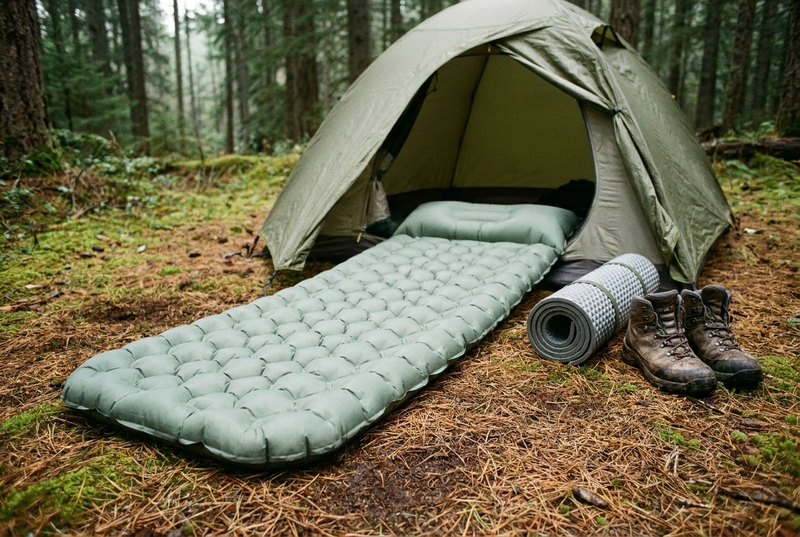
Air cells are many small chambers arranged in a grid, typically formed by joining the top and bottom at points instead of along lines. REI's article speaks of quilted baffles, and we read that as this kind of pattern.
What the sources say about how they feel:
- REI: some campers find that horizontal baffles feel more stable and comfortable, while others like the cradle effect of vertical baffles. Quilted baffles, it adds, claim to spread pressure points better than parallel channels.
- Sea to Summit, which builds its pads from cells, describes its Air Sprung Cells as hundreds of small interconnected chambers modeled on the springs in a pocket-sprung mattress, which conform to your body contours. This is a maker describing its own design.
- CleverHiker's review of a pad with lengthwise channels found that its channels can spread pressure slightly less evenly than softer horizontal or cell designs, and that some side sleepers may bottom out if the pad is underinflated.
Our own explanation goes a step further than those three: a channel behaves like a beam. Press on one part and the whole tube resists, so the surface stays flat and feels firm. A cell is small enough to give way on its own while its neighbors hold their shape, so a hip or shoulder sinks in a little and the surface feels softer. That is our description of feel, not a measurement and not something those sources state. None of them says channels are firmer, CleverHiker counts crosswise channels among the softer designs, and makers rarely publish firmness figures you could compare.
Is a firm or a soft pad better for your sleeping position?
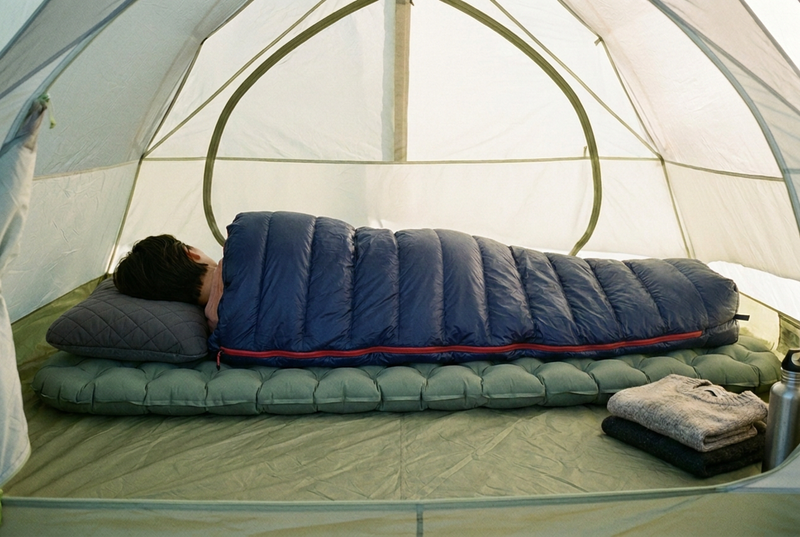
REI's point about position is that side sleepers typically prefer more cushioning to support their shoulders and hips, and that trying pads in person is the best way to find your preference. The table is our summary, not a rule. If you already know which mattress you like at home, trust that first.
| You are | Likely to prefer | Why |
|---|---|---|
| A side sleeper | Softer, or a firm pad with some air let out | Hip and shoulder need to sink in so the pad can fill in at the waist |
| A back sleeper | Either, often firmer | Weight is spread over a large area, so pressure points are rare |
| A stomach sleeper | Firmer | A flat surface keeps the hips from sagging |
| Someone who turns a lot | Firmer and stable | Less wobble when you roll over |
| Sore at hips or shoulders in the morning | Softer, or less air | The surface is not giving way under the high-pressure spots |
| Feeling the ground, or a sagging lower back | Firmer, or more air | You are bottoming out or sinking too far |
Side sleeping has its own guide, with pillow height and a step-by-step inflation check: camping for side sleepers.
One thing you can stop worrying about is your weight. An REI product specialist says body weight need not factor into the choice of an inflatable pad, because the welds and seams hold. A heavier sleeper does press deeper into the same pad, so thickness and a little more air matter more.
Is a firmer pad better for your back?
Not automatically. The belief that the firmest surface is best for a sore back has been tested on mattresses at home. In a randomized trial published in The Lancet in 2003, 313 adults with chronic low-back pain were given either a firm or a medium-firm mattress. After 90 days, those on medium-firm mattresses had better outcomes for pain while lying in bed and for disability than those on firm ones.
A 2021 review of 39 studies in the Journal of Orthopaedics and Traumatology came to a similar conclusion: a medium-firm mattress promotes comfort, sleep quality and spinal alignment. It also notes that a mattress that is too firm does not let the shoulders sink in.
Both concern bed mattresses used for weeks, and the trial studied people who already had back pain. We found no comparable study of camping pads, so treat this as a direction and not a prescription: firm enough to hold your spine level, soft enough that your shoulders and hips are not carrying the load alone. If you have a back condition, follow your doctor's or physical therapist's advice over any gear guide.
How do you set the firmness on the pad you have?
Whichever design you own, the valve gives you a range to work with.
- Inflate the pad fully, then lie on it in the position you sleep in.
- Let air out in short bursts. Stop when the hard spots under you ease but you still cannot feel the ground.
- Roll over once. If the pad wobbles or you slide toward an edge, add a little air back.
- Check again right before you go to sleep.
The last step matters because a pad set in a warm afternoon will be softer by night. Big Agnes explains in its sleeping pad tips that as temperatures drop overnight the air inside cools and contracts, which may make the pad feel less inflated. It calls this normal and says to add a few more breaths. The reverse also applies: release a bit of air before leaving an inflated pad in hot weather.
There is a limit in each direction. Let too much air out of a firm pad and you bottom out before it feels soft. Pump a soft pad hard and it turns into a board. GearLab, citing an experiment by Backpacking Light, notes that more air makes a pad warmer, but also very firm, which many people find uncomfortable. If you are always at one end of the range, the other construction would suit you better.
Mattress Pro V2 or Mattress Pro: which of our two pads?
We sell one of each kind, and they differ mainly in feel.
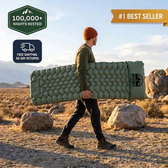
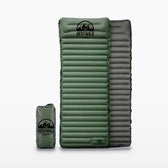
- Restwild Ultralight Mattress Pro V2: built from air channels that run across the pad, which makes it the firmer of the two. It has a built-in pillow and a double valve, is made of 40D polyester, weighs about 2 lb (900 g) and comes in green, brown and black.
- Restwild Ultralight Mattress Pro: built from air cells, which makes it the softer of the two. It is made of 40D nylon with TPU, weighs 1.75 lb (800 g) and comes in green, gray and blue.
What they share: both are 4 in (10 cm) thick, 77 x 27.5 in (195 x 70 cm) and have a built-in foot pump, so you can add air without blowing into the pad. Both have a stated R-value of 4. The product pages do not name the test standard behind that figure, so read it as the stated value and not as a lab-certified one.
Pick the Pro V2 if you sleep on your back or stomach, move around a lot, or find soft air pads unsteady. Pick the Mattress Pro if you sleep on your side or want the lighter pad. Neither is the right pad if weight is your first priority: the lightest insulated air pads weigh under 1 lb (454 g), according to REI.
Both models have connectors along the sides that join two or more pads into a wider bed. The product pages describe joining pads of the same model. They do not say whether a Pro V2 joins to a Mattress Pro, so do not count on mixing them.
Does firmness change how warm a pad is?
Construction and warmth are separate questions. Warmth is given by the R-value, and here the two pads are stated as equal. A stated R-value of 4 is the start of REI's cold-weather band of 4 to 5.4. On frozen ground or snow, add a closed-cell foam mat underneath. For the rest of a cold night, see how to sleep warm in a tent.
Gear mentioned: the Restwild Ultralight Mattress Pro V2 and the Restwild Ultralight Mattress Pro. See the whole sleep system.
Frequently asked questions
Is a firm or soft sleeping pad better for side sleepers?
Softer, within limits. A side sleeper's hip and shoulder need to sink in far enough for the pad to support the waist, but not so far that they touch the ground. A thick pad with a little air let out usually does it.
Are horizontal or vertical baffles better?
Neither is better for everyone. REI says some campers find horizontal baffles more stable and comfortable, while others like the cradle effect of vertical ones. Try both lying in your own sleeping position if you can.
Can you make a firm sleeping pad softer by letting air out?
Yes, up to a point. Releasing air softens any air pad, but if you let out too much, your hip or shoulder reaches the ground. A thicker pad gives you more room to soften it before that happens.
Is a firmer sleeping pad warmer?
Not because of its construction. Warmth is described by the R-value, and a firm and a soft pad can have the same one. GearLab does note that the same pad is warmer with more air in it.