How to choose a sleeping pad: R-value, thickness and weight

To choose a sleeping pad, start with warmth: match the pad's R-value to the coldest night you expect, which by REI's guideline means under 2 for warm nights, 2 to 3.9 for nights down to about freezing, 4 to 5.4 for cold nights and 5.5 or more for very cold ones. Then pick the pad type, thickness, width and weight that fit how you sleep and how far you carry it. No pad is best at everything, so decide which two qualities matter most to you and accept a compromise on the rest.
Why does a sleeping pad matter so much for warmth?
The ground is almost always cooler than your body, and wherever you press against it you lose heat by conduction. Your sleeping bag cannot stop that on its own. Down and synthetic fill insulate by holding still air in their loft, and your body weight squashes the fill underneath you nearly flat. Therm-a-Rest makes the same point in its explanation of R-value: compressed down fails to form an insulating layer between you and the ground.
So the bag or quilt handles the air above and around you, and the pad handles the ground. A warm bag on a thin pad still sleeps cold. Bag ratings are also measured on a warm pad: REI says its sleeping bags are tested on a surface equal to an R-value of about 5.4, more than most three-season pads have, which is one reason a bag can feel colder than its label. Our guide to sleeping bag temperature ratings covers that side, and how to sleep warm in a tent puts the whole system together.
What is R-value?
R-value is a measure of thermal resistance: how strongly something resists heat flowing through it. It is the same measure used for building insulation. For a sleeping pad, three things are worth knowing:
- Higher is warmer. A pad with R 4 resists heat flow twice as well as a pad with R 2.
- R-values add. Put one pad on top of another and you can add the two numbers together.
- It is not a temperature rating. No R-value guarantees comfort at a given temperature. Your bag, your clothing and whether you sleep warm or cold all change the result.
How is R-value tested? The ASTM F3340 standard
Since 2018 there has been one lab test for all pads: ASTM F3340, the Standard Test Method for Thermal Resistance of Camping Mattresses Using a Guarded Hot Plate Apparatus. The first version is F3340-18 and the current one is F3340-22. According to ASTM, the pad is held under a constant compressive force between a guarded hot plate and a cold plate, and the test measures steady heat flow straight down through the pad. The method covers air pads, self-inflating pads and closed-cell foam mats, so you can compare across types.
ASTM's public summary does not list the settings. Outside magazine, which spoke to Therm-a-Rest's engineers when the standard was announced, described a cold plate held at 41°F (5°C) and a hot plate at 95°F (35°C). The energy needed to keep the hot plate at that temperature is measured over four hours. The less energy it takes, the better the pad insulates and the higher its R-value. Three samples of the same pad are each measured in three places and the results are averaged.
ASTM is clear about the limit of the number. It is a repeatable comparison, not a prediction: heat lost through the pad's edges, through uncovered surfaces and through changes in your sleeping position is not captured by the test.
Why older or untested R-values are not comparable
Before the standard, each brand measured R-value in its own way, and some published only an estimated temperature range. REI describes 2020 as the year that changed: from the 2020 model year it accepted new pads only with an R-value from the ASTM test, and Sea to Summit states it has used the test since January 1, 2020. A figure from before that, or from a pad whose maker does not name the test, is not wrong by definition, but you cannot tell how it was reached. Look for "ASTM" or "ASTM F3340" next to the R-value on the packaging or product page. If it is missing, treat the number as the maker's own figure and leave yourself a margin.
What R-value do you need?
Plan for the lowest temperature you expect at night, not for the name of the season. The ranges below are REI's published guideline, which pairs each pad range with a sleeping bag rating.
| Conditions | Expected nighttime low | Pad R-value | Bag rating to pair |
|---|---|---|---|
| Warm | 50°F (10°C) | Under 2 | 30°F (-1°C) or lower |
| Cool | 32°F (0°C) | 2 to 3.9 | 20°F (-7°C) or lower |
| Cold | 20°F (-7°C) | 4 to 5.4 | 15°F (-9°C) or lower |
| Very cold | 0°F (-18°C) | 5.5 or more | 0°F (-18°C) or lower |
Move up a band if you sleep cold. REI also points out that ground temperature matters: early in the warm season the earth has not warmed up yet and draws more heat than it does at the end of that season, at the same air temperature.
Air, self-inflating or foam: which pad type?
| Type | Strengths | Trade-offs | Suits |
|---|---|---|---|
| Air pad | Thick, light, packs smallest, adjustable firmness | Can puncture, costs more as it gets lighter, some are noisy | Backpacking, side sleepers |
| Self-inflating | Stable, quiet, foam adds comfort and insulation | Heavier and bulkier than air pads, can still puncture | Car camping, short walks |
| Closed-cell foam | Cannot leak, cheap, durable, doubles as a seat | Firm, bulky, most are around R 2 | Budget trips, under another pad |
One habit helps with any inflatable: air pads lose pressure as the temperature drops in the evening, so check the firmness and top up just before you go to sleep.
How thick should a sleeping pad be?
Thickness is about comfort, not warmth. A thick pad with little insulation inside can be colder than a thinner insulated one, which is why you compare R-values and not inches. For comfort, your sleeping position decides. Back sleepers spread their weight over a larger area and often manage with a thinner pad. Side sleepers load the hip and shoulder and generally need more depth so those points do not reach the ground. REI's staff say side sleepers often settle on about 4 in (10 cm), while an ultralight pad might be 2.5 in (6 cm). For more on this, see camping for side sleepers.
How much should a pad weigh, and how small should it pack?
Weight, warmth and durability pull against each other. Insulation adds weight, tougher fabric adds weight, and the lightest pads use thinner materials that puncture more easily. The lightest insulated full-length air pads now weigh under 1 lb (454 g). Foam and plush self-inflating pads roll into bundles 20 to 27 in (51 to 69 cm) long and usually ride outside the pack. The farther you walk, the more weight and packed size should count.
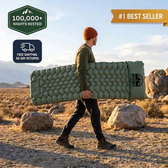
As one example, the Restwild Ultralight Mattress Pro is an air pad that is 4 in (10 cm) thick with a stated R-value of 4.0, which taken at face value is the start of the cold band in the table above. With its built-in foot pump it weighs 1.75 lbs (800 g) and packs to 11 x 5.5 in (28 x 14 cm), so it is heavier than the lightest pads.
What width and length do you need?
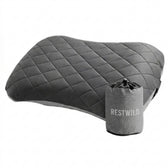
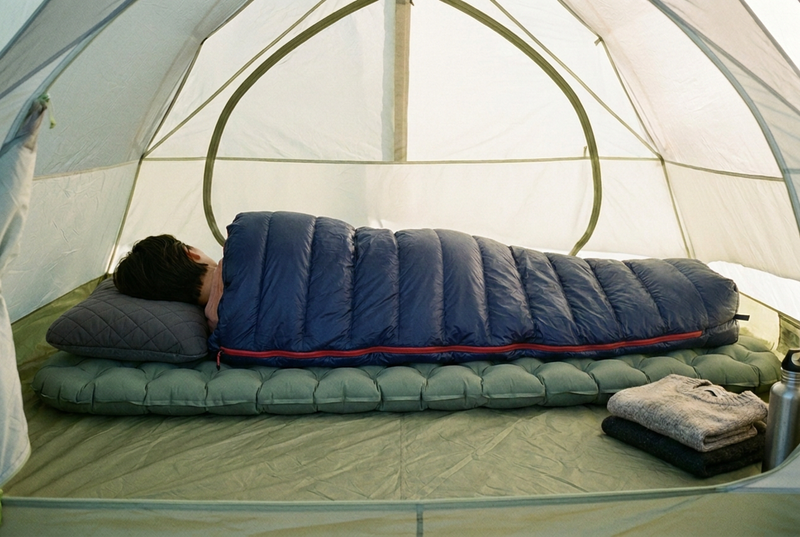
According to REI, most pads are 20 in (51 cm) wide and 72 in (183 cm) long. If you are broad or you turn a lot, look at 25 or 30 in (64 or 76 cm), and check that the pads fit your tent floor. Long pads of about 78 in (198 cm) keep a tall sleeper's feet insulated. A rectangular pad gives you room to move, and a tapered one saves weight if you lie still. If your pillow slides off at night, one with a strap that holds it to the pad, like our Ultralight Camping Pillow, fixes that.
Inflation, noise and repair
Pump sack, built-in pump or breath?
A pump sack is a light bag that clips to the valve: you catch air in it and roll it into the pad. A built-in hand or foot pump needs no extra parts. Both keep your breath out of the pad. REI's advice is that moisture from breath can get trapped inside and may in time degrade the pad or let mold grow, and that storing the pad unrolled with the valve open helps it dry.
Noise
Some air pads use a reflective film inside to hold heat, and that film can crinkle when you move. Self-inflating pads are generally quiet. If noise bothers you, lie on the pad and roll over before you buy it.
Durability and repair
Fabric thickness is given in denier (D): a 20D shell is easier to puncture than a 70D one, though the fiber itself matters too. Carry a patch kit on every trip with an inflatable pad. A small hole in the fabric can be patched in the field. A split seam or a failed valve usually cannot.
Should you stack two pads in winter?
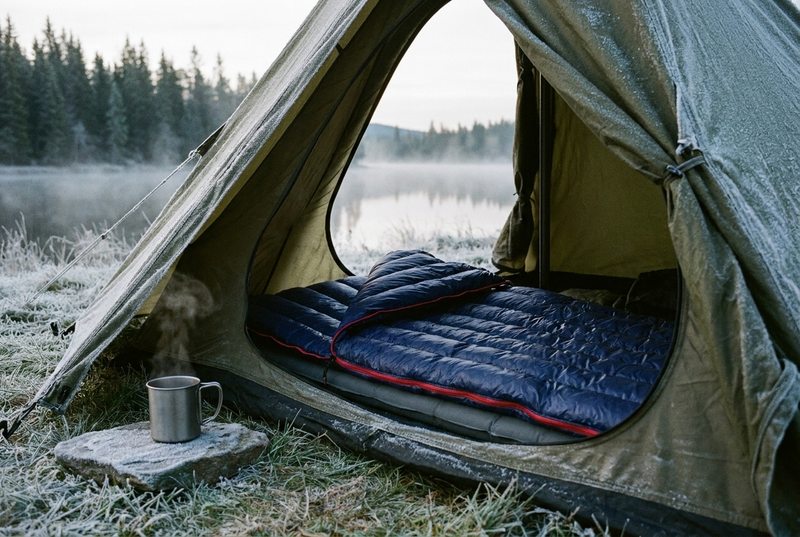
Yes, on snow or frozen ground it is the simplest way to add warmth. Because R-values add, a closed-cell foam mat under an inflatable pad raises the total: Therm-a-Rest gives the example of an R 4.5 air pad on an R 2.0 foam pad for a combined R-value of 6.5. The foam also protects the inflatable from punctures and is your backup if it fails. This is our own advice for the Mattress Pro as well: on frozen ground or snow, put a closed-cell foam mat under it.
Frequently asked questions
What R-value do I need for three-season camping?
By REI's guideline, an R-value of 2 to 3.9 suits nights with a low around 32°F (0°C). If you sleep cold or expect frost on the ground, choose 4 or higher.
Is a thicker sleeping pad always warmer?
No. Thickness mostly decides comfort, while warmth depends on the insulation inside the pad. Compare R-values, not inches.
Can you add the R-values of two sleeping pads?
Yes. R-values are additive, so an R 2 foam mat under an R 4 pad gives a total of about R 6, provided both numbers were measured the same way.
Can I compare R-values from different brands?
Only when both were measured with the ASTM F3340 test, which most major brands have used since 2020. A number without the standard named next to it is the maker's own figure and may not line up with tested pads.