Sleeping bag temperature ratings: comfort, limit and extreme

A sleeping bag's comfort rating is the lowest temperature at which a typical cold sleeper stays comfortable in a relaxed position, and the limit rating is the lowest temperature at which a typical warm sleeper gets through the night curled up without feeling cold. The extreme rating is a survival figure, not a sleeping temperature. If you are unsure which one applies to you, match the comfort rating to the coldest night you expect.
Where do sleeping bag temperature ratings come from?
The three numbers come from one laboratory test. It started as the European standard EN 13537, published in 2002 and in use across Europe from 2005. In 2016 it became an international standard, ISO 23537-1, and the current edition dates from 2022, according to ISO's catalogue page for ISO 23537-1. REI describes the ISO method as almost identical to the old EN test, so an older EN-rated bag can be compared with a newer ISO-rated one.
Testing is not a legal requirement everywhere. Sea to Summit points out that in North America nothing obliges a brand to test a bag before it prints a temperature on it.
How is a sleeping bag tested?
A heated manikin covered in sensors is dressed in long underwear and socks, zipped into the bag and laid on a sleeping pad in a cold chamber. The lab measures how much electrical power it takes to keep the manikin at a steady skin temperature. The more power needed, the less the bag insulates. A calculation model in the standard then turns that insulation value into temperatures.
Three details matter:
- The pad is warm. The 2002 European standard called for a mat with a thermal resistance of about 0.85 m2K/W, which is an R-value of roughly 4.8, and REI says its own bags are tested on a surface equal to about R 5.4. Most three-season pads insulate less than that. Kansas State University's test lab describes its ISO setup as a manikin on a board with standard thermal underwear and socks, a face mask and a 1.5 in (3.8 cm) self-inflating pad.
- The air is almost still. The original European standard required air movement below 0.5 m/s, which is about 1 mph.
- The manikin does not move. Sea to Summit notes that it never rolls over, squashes the fill with a hip or draws cold air in at the shoulders.
What do comfort, limit and extreme mean?
The standard works with two reference people. Both are 25 years old. The "standard woman" is 5 ft 3 in (160 cm) and 132 lb (60 kg). The "standard man" is 5 ft 8 in (173 cm) and 161 lb (73 kg). Therm-a-Rest quotes the standard's own wording for each range in its guide to EN/ISO ratings, and the table below follows it.
| Rating | What it means | How to use it |
|---|---|---|
| Comfort | A standard woman sleeps in a relaxed posture and is not feeling cold. | Match it to your coldest expected night if you sleep cold or are not sure. |
| Limit (lower limit) | A standard man is curled up in the bag, fighting the cold but in thermal balance. | Use it only if you know you sleep warm. Expect a cool night at this temperature. |
| Extreme | A strong sensation of cold is to be expected, with a risk of health damage from hypothermia. | Emergency only. Never plan a night around it. |
The comfort figure is always the warmer of the first two. In one published lab study of two bags, the comfort ratings were 9 to 11°F (5 to 6°C) warmer than the limit ratings of the same bags.
Which number do brands print on the bag?
It depends on the bag. According to REI, brands generally use the comfort rating as the headline number on women's bags and the limit rating on men's and unisex bags. Rab, for example, names its bags after the limit rating. So a men's or unisex "20" is often a bag in which a cold sleeper is comfortable only at clearly warmer temperatures than 20°F (-7°C).
Also check:
- The name is rounded. REI notes that brands round the tested figure to a number ending in 0 or 5, and no rule says which way. Read the spec, not the name.
- A bare number is an estimate. If a rating does not say "comfort" or "limit", REI's advice is to assume it is the brand's own estimate and not an ISO or EN result. Treat it as a rough guide.
Why does your night feel different from the lab?
The rating describes one bag, one pad, one outfit and two reference bodies. You change most of those.
- Your pad. This is the big one. A study in the International Journal of Occupational Safety and Ergonomics found that pad insulation changed the measured warmth of a bag noticeably. Its authors estimated that a thin 0.4 in (10 mm) foam mat could make the real temperature limits 9 to 11°F (5 to 6°C) warmer than the label. Our guide on how to choose a sleeping pad covers R-value in detail.
- Your body. Metabolism, body type and age differ from the reference sleepers. So does what you ate and drank that evening.
- Your clothes. The test assumes one dry base layer and socks. Less than that, or damp clothing, and the number no longer applies.
- The weather and shelter. Wind, humidity, ground conditions and the type of shelter all shift the result, and the lab has almost no wind.
- Fit and movement. A bag that is too big has more air to heat. One that is too tight squeezes the fill flat.
What does the standard not cover?
ISO's own summary says the standard applies to adult-sized bags for sports and leisure with a limit temperature of -4°F (-20°C) and higher. It does not apply to bags for military use, bags for expeditions in extreme climate zones, or bags for children and babies. For children, ISO explains that no prediction model exists and that the sleep trials needed to build one are not possible for ethical reasons. Ratings on kids' bags and deep-winter bags are therefore brand estimates, however careful.
How do you choose a rating for your trips?
Start from the coldest night you realistically expect, not the average. REI's rule is to pick a rating lower than that temperature, using the comfort rating if you sleep cold and the limit rating if you sleep warm. If you do not know yet, use the comfort rating. A bag that is too warm can be unzipped. A bag that is too cold cannot be fixed at 3 a.m.
REI's lab has also tested bags and pads together. Its sleep system chart pairs them like this:
| Expected night-time low | Bag rating to look for | Pad R-value |
|---|---|---|
| 50°F (10°C) | 30°F (-1°C) or lower | Under 2 |
| 32°F (0°C) | 20°F (-7°C) or lower | 2 to 3.9 |
| 20°F (-7°C) | 15°F (-9°C) or lower | 4 to 5.4 |
| 0°F (-18°C) | 0°F (-18°C) or lower | 5.5 or higher |
Notice the margin in the first rows: for a night at freezing, the chart points to a bag rated well below freezing.
Fill power and fill weight: what do they tell you?
Fill power is the number of cubic inches that one ounce of down fills in a lab test. Higher numbers mean more loft for the same weight. It is a measure of down quality, not of warmth. REI's example: in theory 50 g of 900-fill-power down is as warm as 100 g of 450-fill-power down, and packs to about half the space. Warmth depends on both figures, plus how the down is held in place around you.
Down is light, compressible and long-lived, but it loses insulating efficiency when wet. Synthetic fill keeps insulating when wet and dries faster, at the cost of weight and bulk.
What a 32°F (0°C) bag is for
A bag with a single 32°F (0°C) rating is a bag for mild three-season nights, not for nights at freezing. If that one figure works like a limit rating, most people will be comfortable several degrees warmer than it, in line with the 9 to 11°F (5 to 6°C) gap above. REI's chart points the same way: it pairs a 30°F (-1°C) bag with lows around 50°F (10°C).
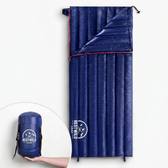
The Restwild Ultralight Goose Down Sleeping Bag shows why it pays to ask which figure a number is. It holds 10.6 oz (300 g) of 800 fill power, 90% goose down and weighs 1.9 lbs (863 g) in total. Its product page shows three figures: comfort 50°F (10°C), limit 41°F (5°C) and extreme 32°F (0°C), without naming a test standard. The 32°F figure is the extreme one, so plan around 50°F: it is a bag for mild nights unless you add insulation. It is rectangular and opens flat, which suits warm nights but leaves more air to heat than a close-fitting mummy bag.
To stretch a bag like this toward colder nights:
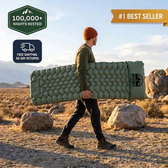
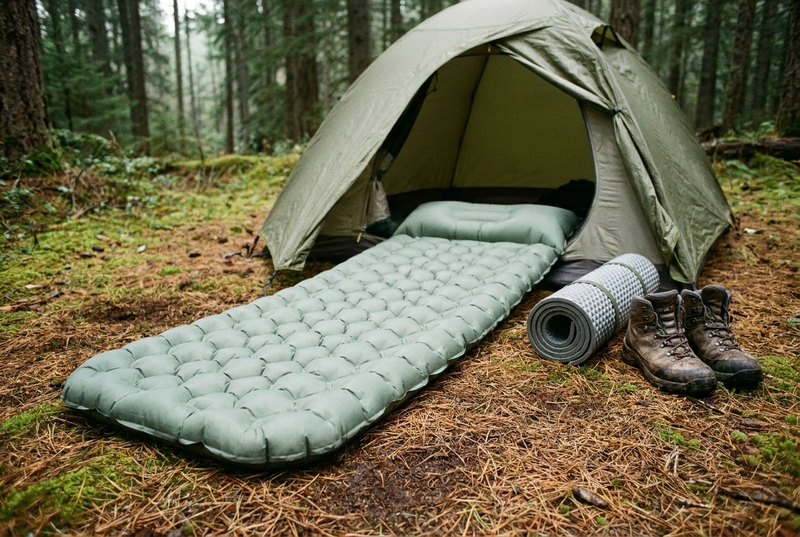
- Put a warmer pad under it. The Restwild Ultralight Mattress Pro has a stated R-value of 4.0. On frozen ground or snow, add a closed-cell foam mat underneath.
- Sleep in dry layers. Long underwear, socks and a hat. Stop adding layers before they compress the fill.
- Add a liner. It gives a little extra warmth and keeps the bag clean.
For the rest of the system, see how to sleep warm in a tent.
Frequently asked questions
Is the number on a sleeping bag the comfort or the limit rating?
It varies by bag. According to REI, brands generally use the comfort rating on women's bags and the limit rating on men's and unisex bags, and a number with neither word next to it is probably the brand's own estimate.
Can you sleep at the limit rating?
A warm sleeper usually can, curled up on a well-insulated pad, but it will not be a cozy night. If you sleep cold, plan on the comfort rating.
Are EN and ISO sleeping bag ratings the same?
Close enough to compare. ISO 23537-1 replaced EN 13537 in 2016 and uses almost the same manikin test, so REI treats an EN-rated bag and an ISO-rated bag as comparable.
Does higher fill power mean a warmer sleeping bag?
Not by itself. Fill power tells you how much loft one ounce of down gives, so a bag with less down of a higher fill power can be colder than a bag with more down of a lower fill power.
Is a 32°F sleeping bag warm enough for freezing nights?
Usually not without help. Expect it to be comfortable on nights some way above freezing, and add a warmer pad, dry layers and a liner if the forecast drops toward 32°F (0°C).