Camping for side sleepers: no more sore hips and shoulders

To camp comfortably as a side sleeper, use a pad thick enough that your hip and shoulder never reach the ground, inflate it slightly soft so they can sink in, and set your pillow high enough to keep your neck level with your spine. A rolled jacket between your knees and a flat, cleared tent site take care of most of the rest. For thickness, outdoor sources point side sleepers to roughly 3 to 4 in (7.6 to 10 cm).
You are in the majority. A study in Nature and Science of Sleep fitted 664 working adults in Denmark with accelerometers and found they spent 54.1% of their time in bed on their side, 37.5% on their back and 7.3% on their front. That was measured in everyday life, not in tents.
Why is side sleeping harder on a camping pad?
It comes down to area. On your back, your weight is spread across your shoulders, back, hips and legs. On your side, most of it rests on a narrow strip: one shoulder and one hip. The same weight on a smaller area means more pressure at those two points. The Sleep Foundation names the shoulders and hips as the places that carry most of a side sleeper's weight, and where pressure points form.
A mattress at home has many inches of foam or springs to absorb that. A camping pad has a few inches of air. If your hip pushes the top of the pad down to the bottom, the pad has bottomed out and you are lying on the ground. Pumping the pad rock hard is not the answer either. The Sleep Foundation notes that a surface that is too firm gives hips and shoulders too little cushioning, while one that is too soft lets the hips sink so far that the spine is pulled out of line.
What should a side sleeper look for in a sleeping pad?
Thickness
REI's sleeping pad advice says side sleepers tend to prefer thicker pads and often settle on about 4 in (10 cm), and it notes that an ultralight pad may be only 2.5 in (6.4 cm) thick. Therm-a-Rest describes its 3 in (7.6 cm) pads as supportive for side sleepers. Put together: treat 3 in as a working minimum, and 4 in as extra room to let air out without touching down.
Width
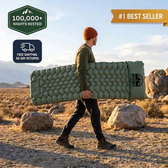
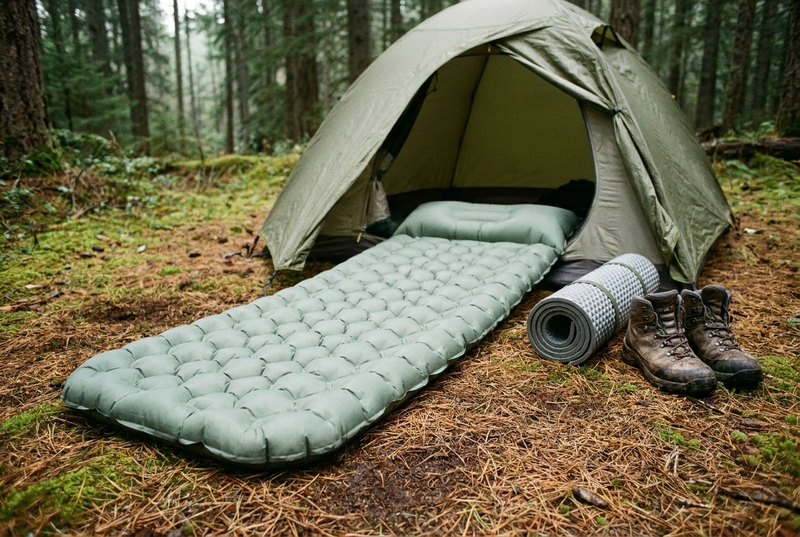
A side sleeper with bent knees takes up more width than someone lying straight. REI notes that most pads are 20 in (51 cm) wide and suggests 25 or 30 in (64 or 76 cm) if you need more space or roll around a lot, if it fits your tent. Knees and elbows that hang over the edge are resting on the tent floor, not on the pad. The Restwild Ultralight Mattress Pro is 4 in (10 cm) thick and 27.5 in (70 cm) wide.
Baffle shape
Baffles are the chambers that hold the air. According to REI, some campers find horizontal baffles more stable, others like the cradle of lengthwise ones, and some pads add thicker side rails to keep restless sleepers centered. It is personal, so try a pad on your side before you commit.
Warmth
Thickness tells you about cushioning and R-value tells you about warmth, so check both. Our guide on how to choose a sleeping pad covers the numbers, and how to sleep warm in a tent covers the rest of the system. The Mattress Pro has a stated R-value of 4.0. On frozen ground or snow, put a closed-cell foam mat under it.
How firm should you inflate a pad for side sleeping?
Slightly softer than full. Tune it in the tent, in the position you sleep in:
- Inflate the pad fully and close the valve.
- Lie on your side with your pillow in place and your knees bent the way you sleep.
- Let air out in short bursts until your hip and shoulder sink in and the pad comes up to meet your waist.
- Slide a flat hand under your hip and press down. You should feel air giving way, not the ground. If you can feel the ground, add air.
- Roll to your other side and repeat the check.
Why does the pad feel softer in the middle of the night?
Because the air inside has cooled. A closed pad holds a fixed amount of air, and the gas laws, as NASA's Glenn Research Center explains them, tie that air's pressure and volume to its temperature. Cooler air pushes less on the pad's walls, so your hip sinks further even though nothing has leaked. Big Agnes describes this softening as normal, and REI advises adjusting firmness right before you go to sleep. The Mattress Pro has a built-in foot pump, so you can top it up without blowing into it.
How high should a camping pillow be for side sleepers?
High enough to fill the gap between the pad and the side of your head, and no higher. The Sleep Foundation says the pillow should fill that space so your head stays level with your spine, and that side sleepers usually need a thicker pillow because the shoulder lifts the head higher. Harvard Health warns against the opposite mistake: a pillow that is too high or too stiff keeps the neck bent overnight and can cause morning pain and stiffness.
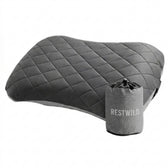
On a pad, the right height changes with your inflation, because a softer pad lets your shoulder sink and shrinks the gap. So set the pillow last. Inflate it fully, lie on your side on the pad, and release air a little at a time until your head tilts neither up nor down. If the pillow is too low even when full, put a folded fleece under it. The Ultralight Camping Pillow is 3.9 in (10 cm) tall when fully inflated, with a valve to adjust it and a strap to hold it on the pad.
Should you put something between your knees?
Yes. Mayo Clinic's advice for side sleepers is to draw the legs up slightly toward the chest and place a pillow between them, which helps line up the spine, pelvis and hips. The Sleep Foundation explains the problem it solves: without support, the top leg drops onto the lower one and twists the spine. In camp, a rolled insulated jacket or a stuff sack of spare clothes does the job. Cleveland Clinic adds two habits: bend your knees only slightly, and change sides regularly.
Which sleeping bag shape suits side sleepers?
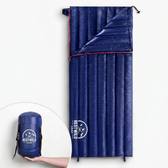
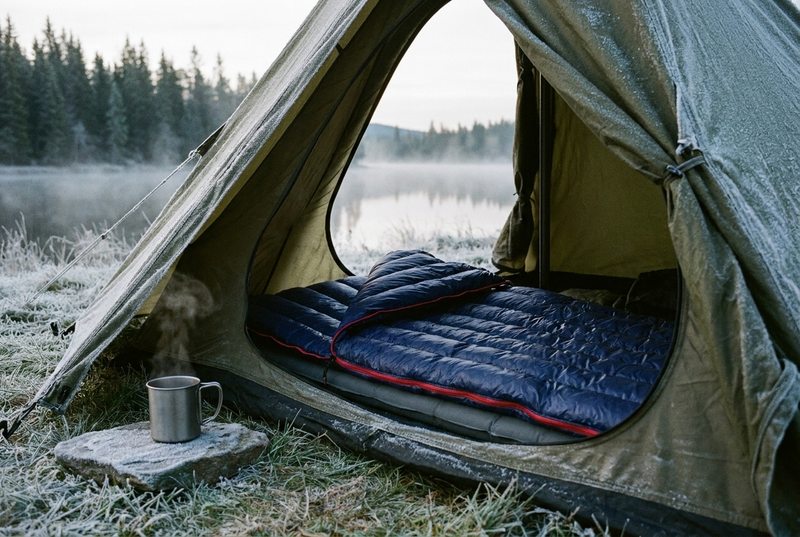
This is a matter of fit, not research. A close-fitting mummy bag does one of two things when you roll onto your side: it turns with you, so the hood ends up over your face, or it stays put and limits how far you can bend your knees. A rectangular bag or a quilt leaves room to bend your knees and turn inside it. The Ultralight Goose Down Sleeping Bag is rectangular, 31.5 in (80 cm) wide, and opens flat. For warmth, see sleeping bag temperature ratings explained.
How do you prepare the tent site?
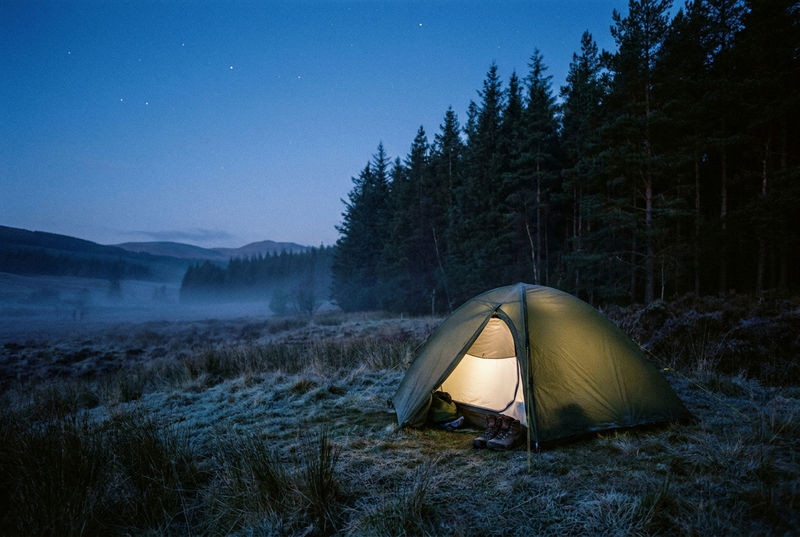
The US National Park Service keeps it simple: find a large, flat place, remove sticks, rocks and pinecones, and orient the tent so your head is on the uphill side. As a side sleeper, add one step: lie on your side on the tent floor before you stake it out, and feel for lumps under your hip and shoulder.
Some older camping guides suggest scooping a shallow hollow in the ground for your hip. Leave No Trace asks campers not to dig or reshape a site, on the principle that good campsites are found and not made, and to put back any surface rocks, twigs or pine cones they moved. A thick pad does the hollow's job without touching the ground.
Side sleeper troubleshooting: problem and fix
| Problem | Likely cause | Fix |
|---|---|---|
| Hip touches the ground | Pad too thin, too soft, or the air has cooled | Top up before sleep. If it still bottoms out, use a thicker pad |
| Sore or numb shoulder | Pad too firm or pillow too low | Let out a little air, raise the pillow, change sides |
| Stiff neck in the morning | Pillow too high or too low | Reset pillow height lying on your side on the pad |
| Sliding off the pad | Sloping site or narrow pad | Re-pitch flatter, head uphill. Try a wider pad or side rails |
| Lower back ache | Top leg dropping forward, or hips sinking too far | Jacket between the knees. Add a little air |
When is the soreness not the pad?
If hip or shoulder pain is severe, keeps getting worse or follows you home, see a doctor or physical therapist. The NHS advises seeing a doctor if hip pain has not improved after two weeks of treating it at home, and gives the same two-week guide for shoulder pain. For shoulders, it also lists pins and needles that do not go away as a reason to seek help urgently.
Side sleeper setup checklist
- Pick the flattest spot, clear sticks and stones, pitch with your head uphill.
- Inflate the pad fully, then let air out while lying on your side.
- Set pillow height last, lying on the pad.
- Put a rolled jacket between your knees.
- Top up the pad right before sleep.
Frequently asked questions
How thick should a sleeping pad be for side sleepers?
Aim for at least 3 in (7.6 cm), and 4 in (10 cm) if you can carry it. REI reports that side sleepers often settle on about 4 in, and Therm-a-Rest describes its 3 in pads as supportive for side sleeping.
Is a firm or soft sleeping pad better for side sleepers?
Slightly soft. Inflate the pad fully, lie on your side and let air out until your hip and shoulder sink in, but stop while you still cannot feel the ground under your hip.
Why does my sleeping pad go soft during the night?
Usually because the air inside has cooled. Cooler air pushes less on the walls of the pad, so it feels softer even when no air has escaped, and the effect is stronger if you inflated it with warm breath. Top it up right before you go to sleep.
Is a closed-cell foam pad enough for side sleepers?
For most side sleepers, not on its own. REI describes closed-cell foam pads as relatively stiff and firm, and less comfortable than air pads. They are more useful under an inflatable pad, where REI notes they add insulation and help protect it from punctures.