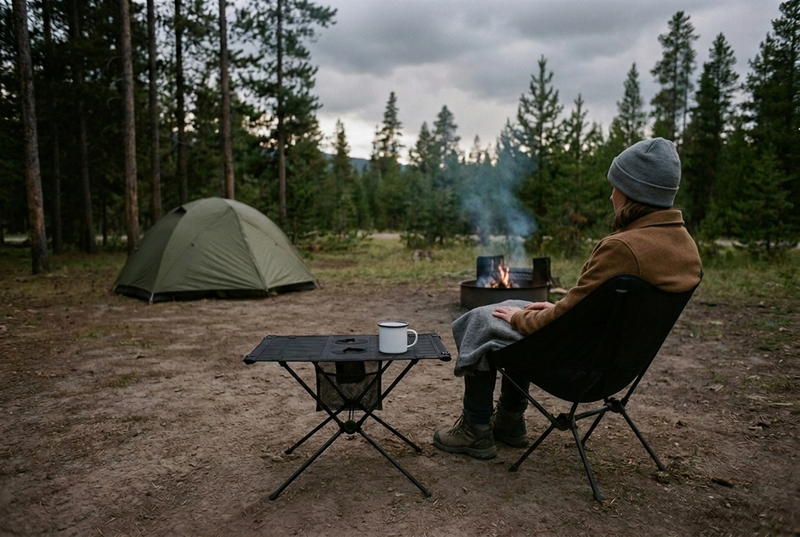
How to stay warm at camp: legs, layers and the campfire hours

To stay warm at camp when you are not in your sleeping bag, add layers the moment you stop moving, give your legs the same insulation and wind protection you give your upper body, and put something between you and whatever you sit on. Keep eating and drinking, stay dry, and treat the fire as a bonus that warms one side of you, not as your insulation.
Why do you get cold when you stop moving?
Because your heat supply drops while the heat loss carries on. Walking with a pack makes a lot of heat. Princeton University's Outdoor Action guide to hypothermia and cold weather injuries, an older text that we use only for basic physiology, lists exercise and shivering under heat production, and notes that less activity means less heat production. At camp you sit down, and you are no longer making that heat.
You also arrive damp. REI Outdoor School instructor Lindsay McIntosh-Tolle sums it up as "dry equals warm" in REI's article on staying warm without a fire: if you are damp, the water evaporates and makes you colder, so change out of sweaty clothing. Do that first, before you pitch the tent or start dinner.
Her second piece of advice is about timing: do not wait until you are freezing, and prepare for slightly colder temperatures than the forecast predicts.
Why do your legs get cold at camp?
This part is our own reading, not a study. Many campers put three or four layers on their upper body in the evening and leave a single layer of hiking pants on their legs. Three things then work against the legs:
- The seat. The backs of your thighs press against a cold log, rock or chair, and heat flows straight into it.
- The wind. Thin pants let moving air through.
- Stillness. The large leg muscles that kept you warm on the trail are doing nothing.
REI's article points in the same direction for some campers. McIntosh-Tolle says women's feet and hips tend to get really cold when sleeping, and suggests carrying that thinking over to time around camp: thicker socks, a jacket that covers the hips or even a down skirt.
How should you layer your legs?
The same way as your torso. REI's layering basics describes three jobs: a base layer that wicks sweat off your skin, a middle layer that retains body heat, and an outer layer that shields you from wind and rain. Its cold-weather example dresses the legs in all three: long underwear bottoms, fleece pants and rain pants. The same article explains why the outer layer matters: fleece breathes well, but wind blows right through it and steals warmth.
The table shows common leg setups for the evening. It is our summary, not a rule.
| On your legs | Works for | Watch out for |
|---|---|---|
| Hiking pants only | Mild, still evenings | No insulation, and wind goes through |
| Long underwear under hiking pants | Cool evenings, moving around | You have to undress to add it, so put it on before you get cold |
| Rain pants over what you have | Wind and wet | Blocks wind but adds little insulation |
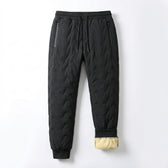
| Fleece-lined or insulated pants | Cold evenings, sitting still | Too warm for hiking. Water-repellent is not waterproof |
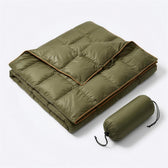
| A blanket over your lap, or worn as a cape | In a chair, by the fire | Keep it clear of sparks, and it slips when you stand up |
Two more points apply to every row. Keep layers loose: the CDC's advice for cold weather is to wear several layers of loose-fitting clothing, and the Princeton guide lists constricting garments and a cramped position among the factors that contribute to cold injuries. And avoid cotton next to your skin when it is cold. REI calls it a no-no in winter because it soaks up water and can chill you.
Our Fleece-Lined Winter Pants combine two of the three jobs in one garment: a thick sherpa fleece lining for insulation inside a quilted polyester shell that is wind-resistant and water-repellent. They have ribbed cuffs at the ankles and an elastic waist with a drawcord. They carry no temperature rating, so we will not tell you how cold they go. They run small: order one size up, and keep that in mind if you plan to wear long underwear underneath. We would pull them on at camp, not hike uphill in them.
Water-repellent, water-resistant or waterproof: what do camp pants need?
The words are not interchangeable. REI's rainwear guide, which is written about jackets, defines them this way:
- Water-repellent describes the surface: a finish that makes water bead up and roll off. REI notes that this is not the same as a fabric being water-resistant.
- Water-resistant gear can handle light rain for a short time.
- Waterproof gear keeps out driving rain.
For sitting around camp on a dry, cold evening, wind resistance and insulation matter most. For steady rain or sitting on wet ground you need waterproof pants over the top. Our fleece-lined pants are water-repellent, not waterproof, so treat them as cold-weather pants and carry rain pants when rain is likely.
What should you sit on?
Something that insulates. HealthLink BC, a British Columbia government health service, lists conduction as one of the four ways the body loses heat, with sleeping on cold ground as its example. McIntosh-Tolle's version is that any time you sit on the cold ground you lose that battle, and the fix is to put something beneath you. The article names an insulated sit pad or a sleeping pad, and adds that even a camp chair helps because it breaks the direct connection with the ground.
A chair with a thin fabric seat still lets cold air reach you from below. Our advice is to fold a foam pad or a blanket onto the seat.
How do you block the wind?
The US National Weather Service explains that wind chill is how cold people and animals feel when outside, and gives an example: at 0°F (-18°C) with a 15 mph (24 km/h) wind, the wind chill is -19°F (-28°C).
The simplest fix comes from REI's article: put on your rain gear even when it is not raining, because gear made to stop wind-driven rain also keeps out wind. Then sit on the sheltered side of a boulder, a stand of trees or your vehicle.
How do you stay warm around a campfire?
A fire warms the side of you that faces it and does nothing for the side that does not. Your insulation still has to do the main work:
- Keep your warm layers on by the fire, especially on your back.
- Put a blanket around your shoulders or over your lap. The Ultralight Puffer Blanket has snap buttons along the edge, so it can be worn as a cape.
- Sit with your back to the wind if the smoke allows.
Fire needs its own rules. The US National Park Service's campfire guidance says to check each park's rules on where and when you can have one, keep the fire small, keep your tent, gear and other flammable objects at least 15 ft (4.6 m) away and upwind, never leave it unattended, and douse it with plenty of water when you call it a night.
The same page has a warning that applies to most outdoor clothing: synthetic clothing melts when it gets hot. Our winter pants have a polyester shell, and the puffer blanket's shell is nylon and polyester. Sit back from the flames, watch for sparks, and do not dry clothes or boots close to the fire.
Never take the fire's job into the tent or a vehicle. Stoves, heaters and lanterns that burn fuel produce carbon monoxide, and how to sleep warm in a tent explains why an open door is not enough.
What should you eat and drink?
Your metabolism is the heater, and it needs fuel. REI's article recommends snacks and warm drinks without alcohol, and says that staying hydrated helps too. Where bears are present, cook and eat away from your tent and store all food the way local rules require.
Skip alcohol as a warmer. The Princeton guide describes it as a vasodilator that increases heat loss from the body's surface.
Move a little before you get cold. McIntosh-Tolle's advice is to stay a little active without working up a sweat.
How do you get from the fire to the sleeping bag?
Go to bed warm: walk around for a few minutes first. Then change into dry sleep clothes: McIntosh-Tolle keeps one set, or at least one pair of socks, that she only wears for sleeping.
Damp clothes stay out of the bag. If your camp pants are dry and loose, sleeping in them is fine and adds a layer. If they are tight inside the bag or you start to sweat, take them off.
When is being cold at camp dangerous?
The CDC lists these warning signs of hypothermia in adults: shivering, exhaustion or feeling very tired, confusion, fumbling hands, memory loss, slurred speech and drowsiness. It notes that hypothermia can occur even at cool temperatures above 40°F (4°C) if a person is chilled from rain, sweat or cold water. Hypothermia is a medical emergency: get medical help as soon as possible, get the person into a warm room or shelter, then remove wet clothing and warm the center of the body. Watch each other, because a confused person may not notice.
Gear mentioned: the Fleece-Lined Winter Pants and the Ultralight Puffer Blanket. See all gear.
Frequently asked questions
Why do my legs get so cold when camping?
Usually because they have one thin layer while your upper body has several, because you are sitting on something cold, and because the leg muscles stop making heat once you sit down. Add an insulating layer and a wind-blocking layer, and sit on a pad.
Are fleece-lined pants warm enough for winter camping?
It depends on the temperature, the wind and how still you sit. Ours have no temperature rating. In deep cold, wear long underwear underneath and windproof or waterproof pants over the top.
Is it safe to wear synthetic pants or a puffer blanket by a campfire?
Only at a sensible distance. The US National Park Service warns that synthetic clothing melts when it gets hot, and we make no flame-resistance claim for either product. Sit back from the flames, watch for sparks and never dry clothing close to the fire.
Should you wear your camp pants in your sleeping bag?
Only if they are dry and loose. Dry clothing adds insulation inside the bag, but damp clothing cools you. A dry set of sleep clothes is the safer habit.