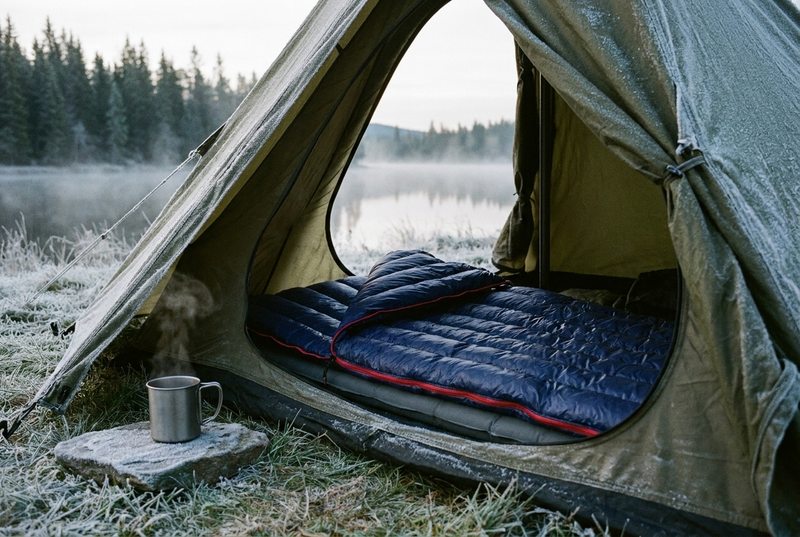
Camp blanket vs sleeping bag: when is a blanket enough?

A camp blanket is enough on mild, dry nights when you have an insulated pad under you and somewhere out of the wind to sleep. Once the night turns cold, windy or damp, a sleeping bag is the better choice, because it closes around you and carries a temperature rating you can plan with.
What is the real difference between a camp blanket and a sleeping bag?
Both do the same job: they hold a layer of still, warm air around you. They differ in how well they keep that air in place.
- Drafts. A blanket is open on every side. The outdoor site Advnture, in its comparison of sleeping bags and blankets, says a blanket will always let some draft in, while a sleeping bag does a good job of sealing heat in.
- Head and shoulders. Many sleeping bags close around the shoulders or have a hood. A blanket has neither, so a hat does that job.
- A rating. A tested sleeping bag comes with comfort, limit and extreme temperatures. Most blankets come with none.
- Freedom. A blanket lets you sprawl, stick a leg out and share. Scout Life's gear columnist points out that camping blankets allow more range of motion while you sleep and are handy for huddling by a campfire.
One thing is the same for both: neither keeps you warm from below. Therm-a-Rest explains in its article on backpacking with a quilt that your body compresses the insulation between you and the pad, so the insulation under you comes mainly from the sleeping pad. That is why a blanket can work at all on a good pad.
Why do most camp blankets have no temperature rating?
The comfort and limit figures on tested sleeping bags come from a laboratory test described in the international standard ISO 23537-1. According to ISO's summary of the standard, it sets out the requirements, test methods and labeling rules for adult-sized sleeping bags. Our reading, from that summary and not from the full standard, is that it was not written with a flat blanket in mind. So treat a temperature printed on a blanket as the maker's own figure unless the maker says how it was tested, and do not compare it directly with a sleeping bag's rating. Our guide to sleeping bag temperature ratings explains what the test measures.
The Ultralight Puffer Blanket has no temperature rating, and we do not give one. How warm a blanket feels depends on how you tuck it, what you wear, the pad under you and the wind.
When is a blanket enough?
Advnture's answer is that it depends on the overnight lows you expect: in milder temperatures and on summer trips, a blanket over you and a good sleeping pad under you can be all the warmth you need. Scout Life's columnist draws the line at the other end: camping blankets are probably not ideal in winter and are great for the rest of the year.
A blanket alone is a reasonable plan when all of these are true:
- The forecast low is mild for you, the kind of night when you would sleep with a sleeping bag unzipped.
- You have an insulated pad or mattress under you, not bare ground or an uninsulated air bed.
- You are sheltered from wind, in a tent, a vehicle or a cabin.
- You and your clothes are dry.
- You have a warmer layer or the car to fall back on.
The table below is our summary of the sources in this guide, not a rule. If you sleep cold, move one row down.
| Situation | What to bring | Why |
|---|---|---|
| Evening at camp, in a chair or by the fire | Blanket | Easy to wrap, move in and share. Keep it clear of sparks |
| Warm night in a tent or car, on an insulated pad | Blanket | Enough cover, with room to vent and move |
| Mild night, low near 50°F (10°C) | Sleeping bag with a comfort rating at or below the low | It closes around you and has a figure to plan with |
| Cool, windy or damp night | Sleeping bag rated for the low, plus the blanket on top | The bag stops drafts, the blanket adds a layer |
| Near freezing or below | A bag whose comfort rating covers the low, and a pad to match | A blanket alone is not a safe plan |
When do you need a sleeping bag?
Take a bag when the night will be cold, when wind can reach you, when you may be damp, or when you cannot bail out to a car. Advnture's view is that a bag built for 20°F (-6°C) insulates better than almost any blanket, which makes the bag the smart choice for cold nights.
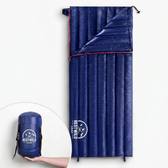
Check which number a bag's rating refers to before you rely on it. Our own Ultralight Goose Down Sleeping Bag lists three: comfort 50°F (10°C), limit 41°F (5°C) and extreme 32°F (0°C). The product page does not name the standard behind them. Plan around the comfort figure, which makes it a bag for mild nights of about 50°F (10°C) and warmer, not a bag for nights near freezing. Its full-length two-way zipper opens the bag completely, so on a warm night it can be spread out and used like a blanket.
Cold does not have to mean frost. The CDC notes in its guidance on preventing hypothermia that hypothermia can occur even at cool temperatures above 40°F (4°C) if a person becomes chilled from rain, sweat or submersion in cold water. A damp sleeper under an open blanket on a breezy night fits that description.
Can you use a blanket and a sleeping bag together?
Yes, and it is the most useful way to carry both. Therm-a-Rest's advice for its quilts carries over, in our view, to a light blanket: use it on its own in summer, and when the nights get colder, combine it with a sleeping bag for a warmer night.
- Put the blanket over the bag, not under you. Under you it gets compressed, and compressed insulation does little. On top it adds a layer and covers gaps at the zipper and shoulders.
- Keep it loose. A bag insulates with its loft, so our advice is not to tuck the blanket so tightly that it flattens the fill.
- Do not treat the pair as a rated system. Treat the blanket as a margin, not as a reason to camp colder than your bag's comfort figure.
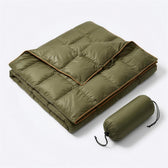
The Puffer Blanket weighs 1.3 lb (600 g) and measures 79 x 55 in (200 x 140 cm), which is wide enough to cover a single sleeping bag with room to spare.
How do you sleep warmer under a blanket?
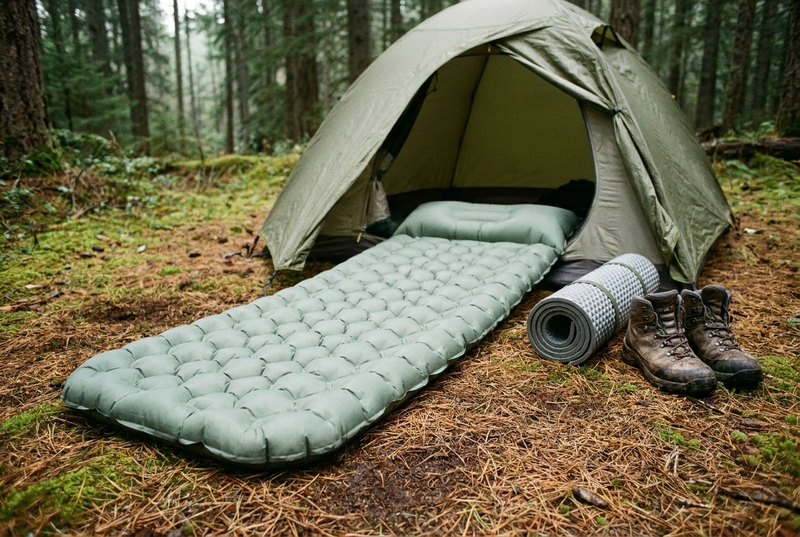
- Start with the pad. REI's sleeping pad advice rates pads with an R-value under 2 for warm weather and 2 to 3.9 for cool weather, and notes that sleeping bag temperature ratings assume a pad with an R-value of 4. See how to choose a sleeping pad.
- Close the edges. Tuck the blanket under your sides and feet. The Puffer Blanket has snap buttons along the edge that turn it into a simple sleeping bag. As a sleeping bag it is for mild nights only.
- Wear a hat and dry layers. Therm-a-Rest notes that because a quilt has no hood, you need something to keep your head warm, and a simple beanie will do. The same goes for a blanket.
- Get out of the wind. HealthLink BC, a British Columbia government health service, lists four ways the body loses heat. One is convection, where moving air carries heat away, and it adds that wet clothing greatly increases heat loss. An open blanket gives moving air an easy way in.
Our guide on how to sleep warm in a tent covers the rest of the system.
Which is lighter and smaller to pack?
It depends on the two products, so compare the numbers and not the category. Advnture's general point is that a blanket has less material and no zipper, so it is often the lighter and smaller of the two. Among our own products, the weight follows that pattern and the packed size does not: the Puffer Blanket weighs 1.3 lb (600 g) and packs to 16 x 9 x 9 in (40 x 22 x 22 cm) in its drawstring stuff sack, while the down sleeping bag weighs 1.9 lb (863 g) and packs to 14.2 x 6.7 in (36 x 17 cm). The bag is heavier but smaller in the pack.
A blanket earns its space in other ways. It works around camp in the evening, it spreads flat for two people to sit on, and the Puffer Blanket's snaps let you wear it as a cape.
When is being cold more than a comfort problem?
The CDC lists these warning signs of hypothermia in adults: shivering, exhaustion or feeling very tired, confusion, fumbling hands, memory loss, slurred speech and drowsiness. Hypothermia is a medical emergency. The CDC's advice is to seek medical attention as soon as possible, get the person into a warm room or shelter, then remove any wet clothing and warm the center of the body: chest, neck, head and groin.
If you wake up cold under a blanket, act early: add dry layers, eat something, and move into a sleeping bag or the car. Do not warm a tent with a stove, lantern or heater. A 1999 CDC report on carbon monoxide deaths among campers says fuel-burning equipment should never be used inside a tent, camper or other enclosed shelter, and that opening the tent flaps is not enough to prevent a dangerous buildup.
Gear mentioned: the Ultralight Puffer Blanket and the Ultralight Goose Down Sleeping Bag. See the whole sleep system.
Frequently asked questions
Can you use a blanket instead of a sleeping bag for camping?
Yes, on mild and dry nights, if you sleep on an insulated pad and out of the wind. For cold, windy or damp nights, take a sleeping bag with a comfort rating that covers the forecast low.
What temperature is a camping blanket good for?
There is no standard answer, because the laboratory test behind sleeping bag ratings is written for sleeping bags, and most blankets carry no rating. Published advice places blankets in mild and summer conditions. Our Ultralight Puffer Blanket has no temperature rating.
Should a blanket go over or under a sleeping bag?
Over. Insulation under your body is pressed flat by your weight, so the pad has to do the work underneath. Laid loosely on top, a blanket adds a layer.
Is a camping blanket the same as a backpacking quilt?
Not quite. A backpacking quilt is shaped for sleeping and often attaches to the sleeping pad to stop drafts, while a camp blanket is a flat rectangle for general use. A blanket with snaps along the edge sits between the two.